
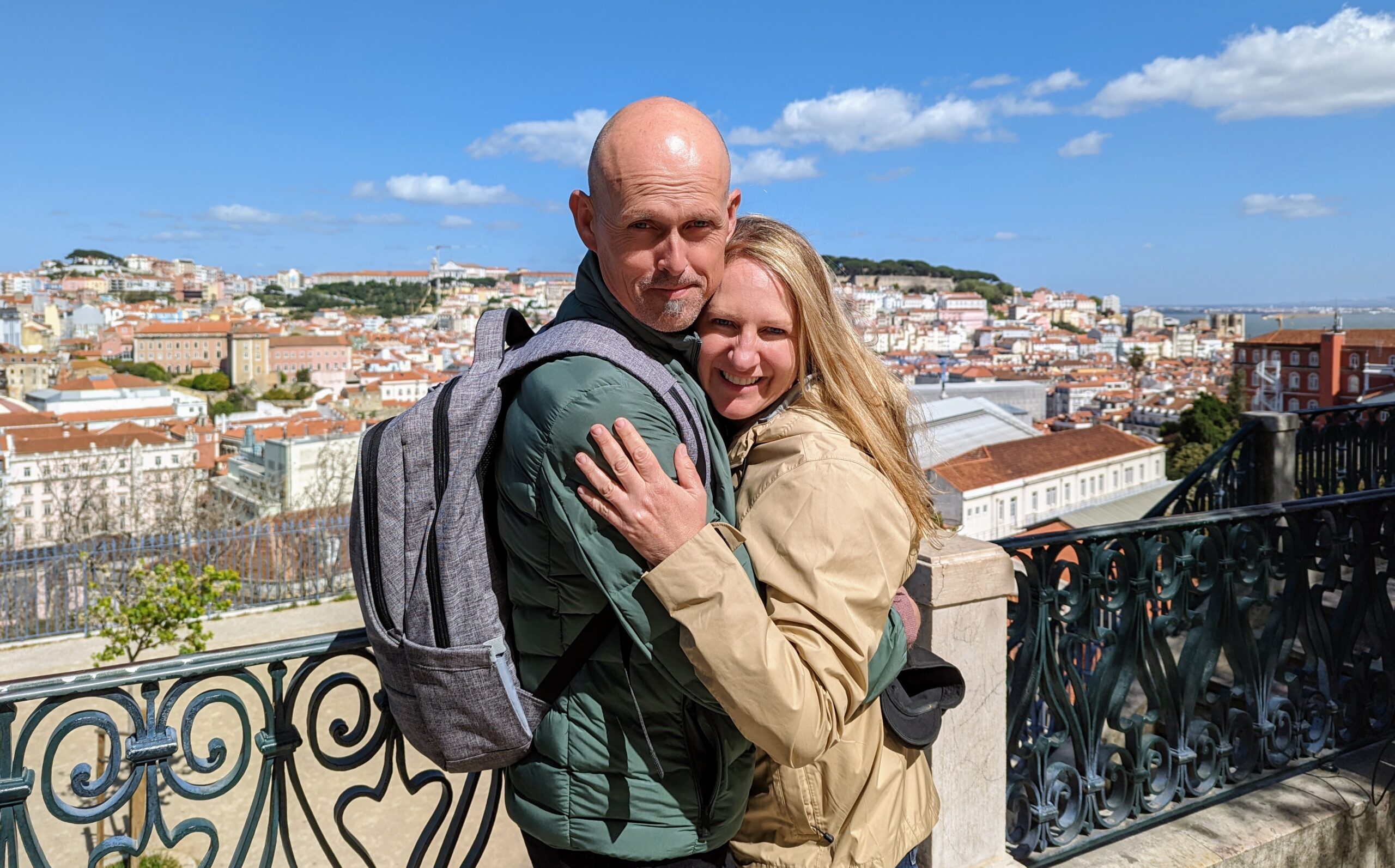
Lisbon
So we hit the road from the Algarve to Lisbon (Lisboa in Portuguese). I’m embarrassed to say that we’d had a rental car for three days, but this trip was basically the only thing we used it for. Portugal is not a large place—it’s about a fifth the size of California, with similar proportions—but this trip halfway up the country still took a good three hours on the highway. One thing that Portugal does not have is high-speed rail, so this was the fastest way to get there other than flying.
As we sped along the inland highway through the hills, we were surprised both how green and how empty they were. At times, the oak-studded countryside bore an uncanny resemblance to the Santa Ynez Valley in spring. With only 10 million people, most of them clustered along the coast, it was comforting to see that even such an old country as Portugal still had plenty of unspoiled expanses like these.
As we approached Lisbon from the south, it was impossible not to see some parallels with our own San Francisco. It’s situated midway up the west coast, overlooking the inlet to a large bay, which is traversed by a big red bridge—apparently modeled after SF’s Bay Bridge and painted to match the Golden Gate! The city is is draped over a series of steep and unruly hills, much like SF’s famous topography, and is filled with rows of brightly colored historic buildings, Lisbon’s own painted ladies. And the famous old trams traversing the hills are strikingly similar to SF’s cable cars—except that Lisbon’s are not just a tourist attraction, but also a legitimate form of transportation.


Of course, there are some pretty obvious differences. Like the giant Christ statue, modeled after Rio de Janeiro’s, watching over the city from across the river. And the distinct lack of any phallic Salesforce Tower or other skyscrapers dominating the skyline as in SF. Lisbon may be Portugal’s biggest city and capital, but it doesn’t feel big, and even from a distance, there was something sweet and charming about it. She was grand, without feeling pretentious. We immediately knew we were going to like it here.

Well, everything except the driving. Navigating the impossibly narrow, winding, and steep cobblestoned streets of our hilltop neighborhood was just as difficult as in all the old cities of Spain, trumped only by the difficulty of finding a parking spot near our apartment. Once I finally did (after dropping off Amy & Griffin), I was surprised when a first floor window slid open next to me and a cheerful elderly woman leaned out of it and started chatting with me in Portuguese…paying no attention to my befuddled look and that I obviously didn’t understand a thing she was saying. I’d finally found someone in Portugal who didn’t speak English! Luckily, Amy and Griffin appeared a few moments later, and Amy (who speaks less Portuguese than I do) somehow managed a conversation with the lady…who then disappeared for a moment and reappeared with chocolates for Griffin. All while I stood there dumbfounded. 😵
Our AirBnB was a large apartment that we guessed had belonged to a prosperous family a century ago, based on its size and incredibly ornate high ceilings. Luckily, it had gotten several updates since then, including a new kitchen and bathrooms, but it still managed to exude plenty of the well-used shabbiness that seems to define Portugal…like the staircase so worn that the treads were more like saddles, or the door handles that occasionally came off in our hands.
We were meeting some good friends here, Angelenos who had relocated to Berlin two or three years earlier. We had first met Nadja and Matt at a festival in Santa Barbara well over a decade ago—the same night they had met each other—and we were also there when he proposed to her (at Burning Man!) a couple years later. Their nine year-old daughter EvaBella has been fast friends with Griffin pretty much since he was born, and she’s been plotting their nuptials nearly the whole time. We hadn’t seen them all since before the pandemic and were looking forward to spending the next week and a half catching up with them and exploring Lisbon and nearby Sintra together. Griffin was just stoked to be hanging with another kid instead of us boring adults!

The next morning, the six of us set out, starting with the quaint yellow trams, which have been rattling around the city since 1873. Originally horse-drawn, the first carriages were called Americanos because they were built in the States. They were electrified in 1901, which allowed them to ascend into some of the more impossibly hilly neighborhoods. The current carriages are known as Remodelado because they had their brakes and motors upgraded in the 1990s (thank goodness!), but otherwise, they are still largely the same wood-paneled carriages that have been plying the cobblestone streets for over a century—because apparently more modern tram cars just aren’t capable of negotiating the hills or turns. For those spots that are too steep even for these little billy goats, there are several funiculars (elevadors) and even a couple of public lifts, which are like giant freestanding Victorian elevators linking different levels of neighborhoods!
Our stop was the end of line 24, so we got a carriage pretty much to ourselves for the return trip to the city center. The kids loved the ride, and we loved the views over the city as we passed various miradoures (viewpoints) on our way down.
We spent the next eight hours exploring the city on foot, getting ice cream and various other treats, including the city’s famous custard tarts (natas) and the cherry liquor served in edible chocolate shot glasses at little corner kiosks. We were impressed by how friendly and safe the city felt; the common-sense vigilance you needed to wear in most American or European cities just didn’t seem necessary here. We didn’t see anybody who appeared homeless, disturbed, or disgruntled, but we did see one guy cheerfully creating cascades of soap bubbles for a flock of children in the main square. Where the city officially greets the River Tagus, at the expansive Praça do Comércio (Commerce Square), dozens of people sat on the wide staircase that marches into the water, happily dangling their feet in the waves. Was everyone in this city just…content?

We finished the afternoon by walking up to one of the city’s most prominent and historic sites, the Castelo de São Jorge. Apparently humans have occupied this hill since at least the 8th century BC, and pretty much every group of people who have spent any time here in the past two millennia has built fortifications here. As castles go, it wasn’t super impressive (not after some of the others we’ve seen recently), but the 360° views over the city more than made up for it…as did the muster of peacocks that roamed the ramparts, filling the air every few minutes with their loud, somewhat unsettling cries.
Over the next few days, we explored the city by boat, by foot, and by tram, falling in love with it more each day. Highlights included:

Walking the Aqueduto das Águas Livres: This Gothic aqueduct near our apartment was built in the 18th century to bring water to the thirsty city from nearby hills, reusing portions of an old Roman aqueduct. It’s no longer used, but we walked along its most spectacular section which soars 200 feet over a valley.

Dining at TimeOut Market: The iconic London events magazine is here in Lisbon too, where they’ve created their own warehouse-sized food court, a trendy venue where we sampled cuisine from some of the top restaurants in town (curated by TimeOut) at long communal tables while sipping cocktails and listening to music.

Exploring LX Market, a run-down row of warehouses that has been reinvented as an edgy arts district, with restaurants, shops, galleries, artist studios, a record store, hostel, and lots of public art. We especially enjoyed the sculptures made of auto parts (like this oversized bee) hanging from the walls.

Visiting the spectacular Oceanário de Lisboa aquarium, which rivals the one in Monterey Bay and seeks to convince the seafaring and seafood-loving country to take better care of its ocean. A giant central glass tank filled with a vast array of fish, including sharks and a rare giant sunfish, is flanked by four smaller habitats, including an icy Antarctic one for penguins. We loved the sea monster made of ocean trash that playfully lurks outside.

Ascending Belém Tower: This adorable 16th century fortification guarding the mouth of the Tagus River has to be the most iconic site in Lisbon, and a great metaphor for the city. Nobody is going to be wowed by its size—the 4-story tower is so small that it almost feels like a scale model of a real castle, complete with a small drawbridge—but the beauty is in the carefully crafted and preserved details. The kids enjoyed playing in the waves that lap its base, while us adults shared a piña colada served in a hollowed-out pineapple, which they sell in the park!
Five days in Lisbon was definitely not enough, and since the moment we arrived, Amy has been talking about getting a place there—or possibly even relocating permanently. It does seem to be the perfect blend of history and modernity, balancing the charms and quirks of a millennia-old city with all the perks of a world-class metropolis. The weather ain’t half bad either, very similar to Santa Barbara’s, and there are plenty of natural spaces to escape to just a few miles from the city. Of course, Lisbon has been enchanting visitors for a long time, but it’s enjoying a bit of a renaissance right now. As I detailed in this post, after years of financial struggles, the country has very successfully lured in foreign investments and foreign residents, which have brought fresh energy and ideas to the country’s capital. Formerly vacant buildings are now inhabited by daring new restaurants (including a lot of vegan ones!) and creative office spaces; young professionals, expats, and digital nomads are snapping up freshly remodeled apartments; and new development is springing up all around the city’s perimeter. But best I could tell, Lisbon is doing a good job of preserving its quaint historic character, at least in the city center. Nonetheless, not everybody welcomes the changes—one taxi driver complained to us that the city is expanding too fast and that traffic is becoming unbearable. (It’s still nothing like LA.) Meanwhile, the influx of new residents is driving up rents and home prices and fueling complaints of gentrification, which I suppose is inevitable. So maybe it’s best that we don’t tell too many people about this little treasure. Let’s just keep it our secret, okay? 😉


Next stop: Sintra, a storybook wonderland come to life!