
Portugal & the Algarve
So we had wrapped up our 2½-week Spanish sojourn in Seville in the midst of Semana Santa. We parted company with Amy’s mom, who headed back stateside, while we hopped on a bus headed across the border to Faro, Portugal, for the next chapter of our journey.
What images come to mind when you think of Portugal? If you said nothing at all, you wouldn’t be alone. Portugal used to be quite the European backwater, a place Americans and many others simply didn’t think to visit. That’s all changed in the past decade, and Portugal is quickly becoming a popular destination for travelers, expats, and surfers—some would say too popular. It’s a secret that the Brits probably wish had not gotten out. They’ve been enjoying jaunts to Portugal since at least 1373, when the two nations aligned their interests under what is now the world’s oldest international treaty relationship that is still in force today.
That special relationship is awfully helpful for Americans like us, because while the Portuguese language is pretty hard to read and almost impossible to understand, just about everything and everyone in Portugal is friendly to English-speakers like us. Of course, quite a lot of Europeans seem to speak English pretty well, but they’re not always so happy to admit it as are the Portuguese. It reminds me of something I once read about the Greeks: they get it that theirs is a dying language that was once important but isn’t anymore, and they don’t expect you to learn it just to come visit them. Perhaps Portuguese isn’t quite the same (because, you know, Brazil), but at least one restauranteur told us not to bother trying to learn her difficult language—and nobody else seemed to shame us for speaking English with them either.
No wonder. Portugal, the poorest country in Western Europe, has been benefitting from British tourism for centuries now. And lately, Portugal has been beckoning the rest of the world come visit as well. Long before we arrived, Amy told me about their popular “golden visa” program that rewarded modest investments in the country, like buying a home or commercial building, with citizenship, not only for yourself, but for your entire family—allowing you to buy your way into being Portuguese, and by extension, EU citizens. It was kind of an amazing deal, and apparently she and her dad had been more than idly toying with the idea. Portugal has also positioned itself recently as a cryptocurrency tax haven (also of interest to Amy!). All this courting of foreign investment and expats has been pretty successful:
In the last decade, the overall population in Portugal has declined even as the number of foreigners has grown by 40%. The ranks of American citizens living in this land of 10 million shot up by 45% last year. Within the mix of retirees, digital nomads and young families fed up with issues including the costs of housing and healthcare, Trumpian politics and pandemic policies, Californians are making themselves known in a country once considered the forgotten sibling of Spain.
“Welcome to Portugal, the new expat haven. Californians, please go home.”
LA Times, May 12, 2022
We were about to see some of the results of this as we crossed the border into Portugal’s southern Algarve region. Nothing about the topography changed much—like southern Spain, this was a fairly arid landscape with a Mediterranean climate, not unlike southern California. As in Spain, herds of sheep grazed amongst olive trees and abandoned stone farmhouses. Amy had told me we were going to a quiet, almost unknown corner of the country, and so it seemed. But as we approached the coast, a profusion of gleaming white high-rises and cranes suddenly sprung up on the skyline. Had we made a wrong turn and ended up in…Florida?

Actually, a better comparison might be Puerto Vallarta or Cancun, Mexico. Here on Portugal’s southern coast, facing Morocco, sleepy old fishing villages like Faro, Albufeira, and Lagos have been transformed into something entirely different by sprawling condo complexes, high-rise hotels, upscale eateries, shopping centers, and golf courses. The charming old cobblestoned town centers are still there, now filled with gift shops and cafés and shaded by modern canvas sailcloths strung between the buildings. Marinas filled with pleasure craft have replaced most of the fishing boats, and previously barren beaches are now slathered with summer sunseekers. Again, the Brits were apparently the first to discover that this quiet, sun-soaked, and always-temperate region was the perfect place to holiday from their gray homeland. And since everything is so much cheaper here…why not buy a summer home and come back every year? Better yet, why not just stay year-round, especially if you can work remotely? This transformation of the Algarve apparently started in the 1960s, but has accelerated dramatically over the past decade, and developers have been happy to oblige the demand.

Photo by Jose A. on Wikipedia
Our coach dropped us at the airport in Faro, the region’s capital. I had expected to find a tiny little regional airport something like Santa Barbara’s. But it was more akin to Burbank’s, only nicer, newer, and more spacious. Apparently, this little hub hosts 28 airlines and 9 million travelers each year, with eight of its ten busiest routes still to the British Isles.

It took us almost an hour to figure out where to get our rental car—Amy said we needed one in the Algarve—but then we were off to explore Faro’s charming town center. We immediately became acquainted with the distinctive Portuguese cobblestones known as calçada—small, slick chunks of ivory limestone and black basalt, often arranged in flowing or geometric patterns or even mosaics—along with two of Portugal’s signature architectural motifs: colorful ceramic wall tiles and peeling paint. Seems that everything that isn’t new in Portugal is old and tattered—with not much in between. As we wandered the narrow lanes of the old town, we discovered lots of wonderful street art, plenty of boutiques, a tiny vegan eatery, and an open-air market selling traditional Portuguese fish products, blood sausage, and sheep cheese. Amy happily bought up some of the latter.


We then moved on to our accommodations in nearby Lagos. Our AirBnB was a condo in a small, simple complex in an area outside of town that seemed recently built out entirely for similar condos. A few blocks away, a new 10-story luxury hotel was just breaking ground. Despite its lack of character, we were happy to be staying in much newer and well-appointed digs, complete with a pool, a front desk, and a food & drink bar where a café com leite was a whopping €1.20.
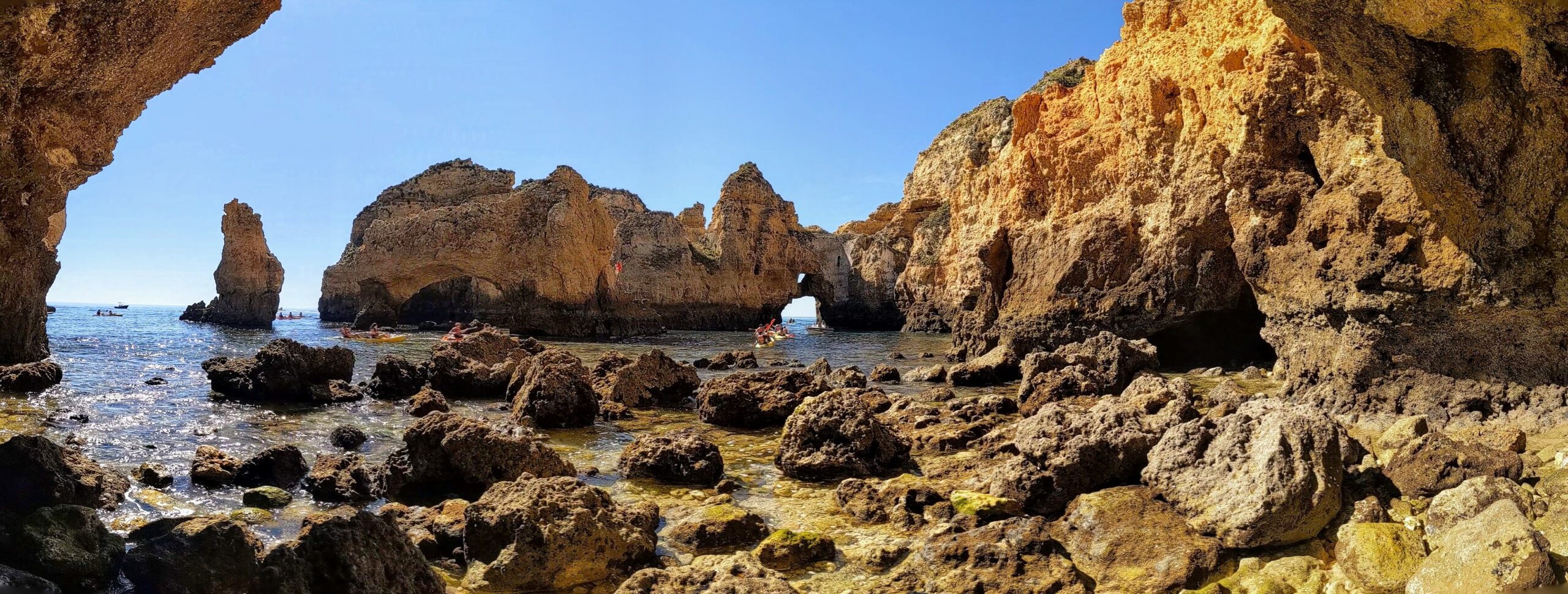
Our first morning, while Amy slept in, Griffin and I found our way out to the coastline, where we discovered what Lagos is most famous for: a series of dramatic red cliffs and sea caves. On a series of well-maintained coastal trails, we passed early-morning joggers as we picked wildflowers and explored some ruined stone buildings that overlooked the ocean, immediately next to a nice new golf course. We gingerly navigated the dangerous cliffs and found the steep path down to a nude beach, then wandered out to the lighthouse where we found a concrete staircase down to what was apparently Lagos’ most popular grotto. There were a few dozen people there, but it was still early enough that the full crush of tourists wouldn’t show up for at least another hour, though some were already arriving by boat and kayak. We brought Amy back the next day and played in the water.


_(10081340626).jpg#/media/File:Albufeira_(Portugal)_(10081340626).jpg)
Most of our three days in Lagos was spent relaxing after a fairly rushed sightseeing itinerary in Spain. We had planned to use our rental car to go exploring, but never did. Griffin and Amy enjoyed a sudden burst of hot weather, a nice change after the rain and cold of Spain, and they spent most of a day getting a well-earned sunburn by the pool. We explored the old town on foot, ate sushi, played in the town’s water fountains, and whiled away a few hours at a small but surprisingly well-appointed children’s museum that overlooked the marina. We could definitely see the appeal of the Algarve—for much the same reasons that Americans love vacationing in Mexico. Things were just so easy there (and cheap!). But before we knew it, our time was up, and we were on the road to our next stop, a destination that showed us a different side of Portugal and stole our hearts: lovely Lisbon.