
Sevilla
After our enchanting adventures in Ronda & Zahara, we hopped in our rental car and headed towards our final destination in Spain: Sevilla (Seville in English). As we approached, we could tell something was different about this place. The highway grew from two to eight lanes, and urban sprawl crept out to meet us. This is no small Andalusian village—this is a big city. Home to about 1.5 million people and the fourth largest city in Spain, in fact.
After navigating all those narrow, cobblestoned medieval lanes in the villages, driving in a big modern city should have probably been a piece of cake. But what we hadn’t realized until a few days before our arrival was that Easter was exactly a week away—and that meant Semana Santa had already begun. What is Semana Santa? I’ll answer that in a moment, but suffice it to say that it’s a very big deal in Seville. The roads that weren’t closed to traffic were swollen with traffic from thousands of visitors streaming into the city. Getting to our AirBnB in the Triana neighborhood wasn’t too bad. But returning our rental car to the train station in the historic city center on my own? That was a completely different story.
I could have taken the boulevard immediately below our apartment straight over the Triana bridge—except that both the street and bridge were closed and packed with humans for what seemed to be the city’s biggest Semana Santa procession that day, gearing up at that exact moment. So I hopped in the car and tried to navigate a confusing and fast-paced alternate route over the river, into the city, and on to the train station amongst thousands of other confused residents and visitors, all whilst while trying to find a gas station en route that was open on a Sunday. That all turned out to the easy part. Finding the rental depot took me another maddening half hour of driving in circles. Rarely has such a short drive brought me so close to a nervous breakdown—and rarely have I been so glad to be rid of a car! Especially after I got the bill. The privilege of 3¾ days of driving in Spain? Over €550 (US$580), more than half of it taxes. Dear reader, if there’s one thing you learn from this blog, it’s this: driving in Europe is a very expensive adrenaline rush. Don’t do it unless you must! Consider bungee jumping instead…it’s certainly cheaper!
Once I was back at the apartment, Amy’s mom Cathy somehow talked me into heading out into the noisy streets to see what Seville’s Semana Santa was all about.
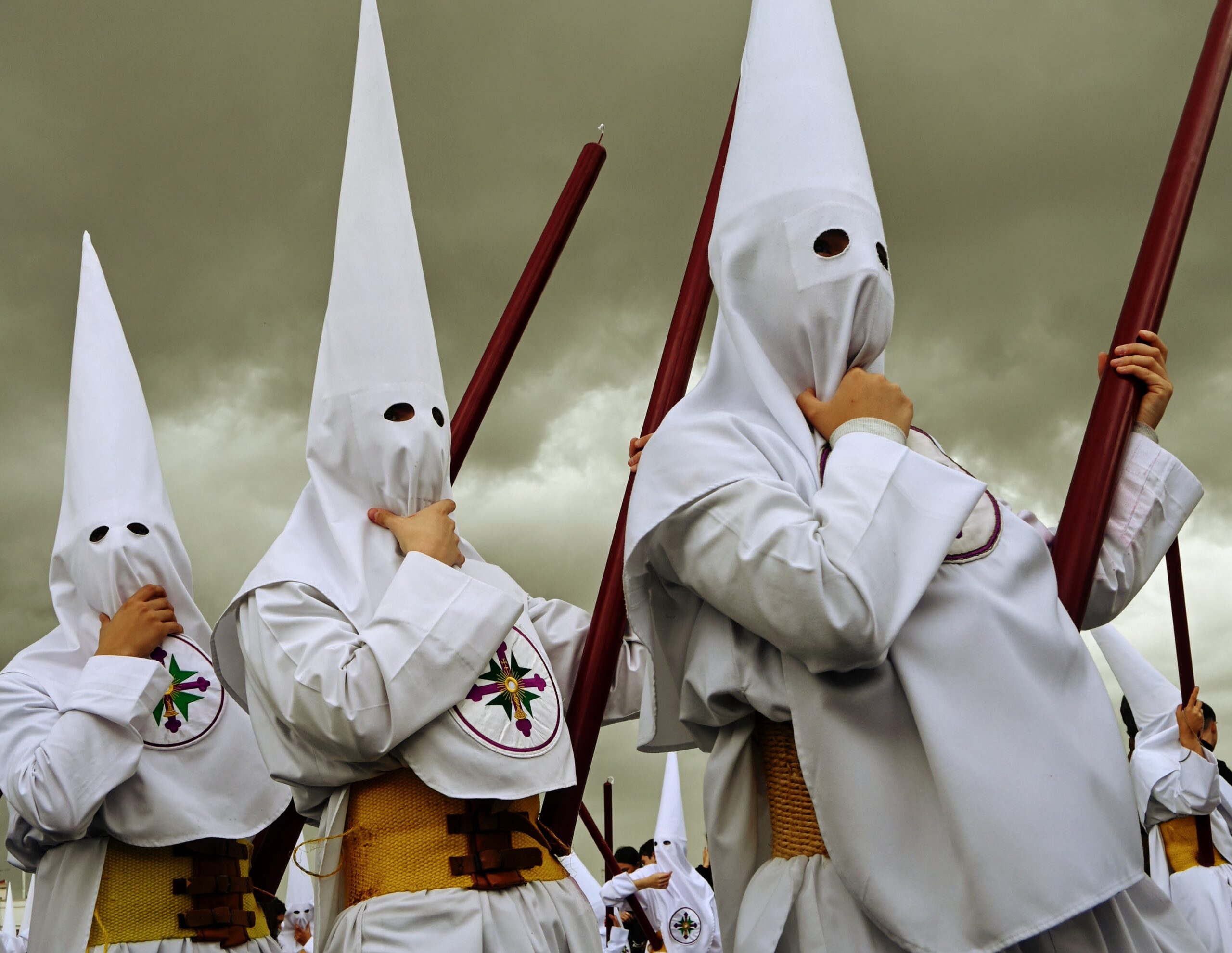
Semana Santa is a week-long celebration that takes place in cities all over Spain—particularly in Andalucia. Of all Spain’s many and varied festivals, Semana Santa is the most sombre but also one of the most captivating. During the festival, thousands of people take part in processions as massive floats carrying religious statues are brought to the church. They are also accompanied by marching bands playing religious music with crowds lining the streets to witness it all.
The festival pays homage to Jesus Christ’s last days before he was crucified. Many floats feature an effigy of him either carrying a crucifix or already on it. The Virgin Mary is also a prominent effigy. At each procession, floats depicting a scene from the Easter story are carried by ‘costaleros’ (like pallbearers) along a set route before reaching the church. They’re followed by ‘nazarenos’ who are often carrying candles, torches or wooden crosses. People taking part are members of a brotherhood, which usually means they belong to the same church. Completely covered in traditional robes and conical hoods, which cover their faces, it’s a haunting sight. Outside of Spain, it’s also the most iconic and curious feature of the celebrations because of their similarity to the robes worn by the Ku Klux Klan. The Spanish tradition, however, has nothing to do with the latter. It actually originates from medieval times where the robes and hoods would be worn by people to show their repentance over past sins.
DriveSpain.com


Amy and I had actually experienced Semana Santa many years ago in Antigua, Guatemala, so we had some idea what to expect—certainly no Macy’s Thanksgiving Day Parade! It’s a strangely serious gathering, with most spectators dressed in their Sunday best, standing around for hours as these floats lumber down the streets—all night long. The floats are massively ornate wooden things, some over a century old, encrusted with jewels and topped with mannequins of Jesus and Mary that are frightfully lifelike, sullen and even gory. The Spaniards are just really into pain and suffering.
Turns out that the particular procession we wandered into, the first of the week, did not go all night and was already dispersing. The mood was already a bit more cheerful as people packed into the local bars and restaurants. I was surprised to find how much cerveza had been quietly consumed during the parade: garbage trucks were swarming to gather up huge piles of bottles. We’d missed the parade that night, but we had three more days to see what it was all about—though I wondered how the rain in the forecast would affect it all. (Turns out that it didn’t slow things down at all!)
Accommodations were scarce that week, so Amy had gotten us the only place she could find—an apartment in a nondescript 6-story building across from the hospital in Triana. This neighborhood was a few hundred years old, but the only signs of this were a few ornate building facades overlooking the cobblestoned main street. Otherwise, it looked to me like any slightly run-down city anywhere. The sort of people who find the tawdry streets of New York or San Francisco “invigorating” would probably find this so too. To me, it was somewhat depressing, especially after experiencing Ronda, Granada, and the white villages. But then we hadn’t yet visited the city’s grand and historic center.
Turns out that what Seville might lack in charm, it makes up for in grandeur. Sevilla has been a big deal for quite a long time—and not just because of Rossini’s opera. It was founded as the Roman city of Hispalis, then known as Ishbiliyah after it was conquered by Muslims in 711. By the 11th century, it had become the capital of the large and powerful taifa of Seville, until falling to the Crown of Castile in 1248. When Columbus set sail for the Americans in 1492, it was from the nearby seaport of Huelva. But it was Seville, 50 miles up the wide Guadalquivir River and Spain’s only river port, that was to profit.

The Spanish kings gave Seville the monopoly of trade with the Americas, quickly making it Europe’s Atlantic gateway and one of the wealthiest cities of the 16th century. To showcase Spain’s newfound wealth and power, vast and lavish Renaissance and baroque buildings were erected. But the most famous of all was the new Seville Cathedral. Built atop the city mosque, construction started in 1401 (decades before Columbus was even born) and was not completed until 1506 (the same year Columbus died). It remains the largest Gothic cathedral and the fourth largest church in the world, and its imposing Giralda Tower seems to be the icon of Seville.
The next day, we trekked over the river to the old city and the cathedral. And all I can say is: wow. I’ve seen St. Peter’s in Rome. The Hagia Sophia in Istanbul. St. Paul’s in London. Best I can remember, none of them hold a candle to the opulence of the Sevilla Cathedral. This place has over 80 individual chapels, each more ornate than the last. The roof is a dizzying cacophony of soaring Gothic arches. Every surface seems adorned with priceless paintings, gold leaf, or the most gorgeous wood & stone carvings. The amount of human labor that was poured into this thing, using 15th century technology, is just…astounding.


Strangely, the cathedral is best known not for any of this artistry, but the fact (legend?) that it is the final resting place of Christopher Columbus—after his remains were moved around the world repeatedly. What’s left of him is supposedly in a casket carried high by the sculptures of four figures representing the kingdoms of Spain—a clever way to honor Columbus’ fervent demand that he not be buried in Spanish soil!
Griffin’s favorite part of the cathedral, however, was the Giralda Tower. Originally built by the Moors for their mosque and later repurposed for the cathedral, it looms over the rest of the old city. Getting up it is no small feat, as there are no stairs or elevators; instead, you must walk up 40 brick ramps, designed so that one could ascend on horseback several times daily to make the calls to prayer. (Clever Moors!) Today, 24 bells mounted in the tower serve a similar purpose (luckily all automated!). The views from the top over the city were stunning—and quite windy.
We spent the rest of our time in Seville walking along the river and exploring the city, getting lost in the winding lanes of the old Jewish Quarter, finding lots of interesting little shops, alternately dodging or getting sucked into more Semana Santa processions, seeking out some wonderful vegan eateries, and doing our best not to get soaked by the occasional rain showers. (Except Griffin, who tries to get wet!) Highlights included:
- exploring the huge Parque de María Luisa in the rain
- traversing the massive, sprawling Plaza de Espana, where we caught a free flamenco show
- walking atop one of Seville’s newer and more psychedelics monuments, the Metropol Parasol, otherwise known as Las Setas (the mushrooms), an insane wooden sculpture that would be right at home at Burning Man
- riding a “flying fox” at a local playground for far too long


.jpg)


That was it for Seville and our sojourn in Spain. Amy’s mom ended her trip with us and flew back home while we caught a bus to our next destination: Portugal! Stay tuned…