
The white villages of Andalusia
On our final morning in Granada, we packed up and prepared for our latest challenge: driving in Spain! Our final stop was Seville, and we definitely could have taken a train or bus to get there. But Amy opted for a rental car so we could could explore some of the towns and villages of Andalusia and the countryside in between.
Great idea, at least in principle. Except that it didn’t occur to either of us to check the requirements for Americans to drive in Spain until, well, a few hours before we picked up the rental car. Turns out that I needed an International Driver’s Permit (IDP) to legally drive in Spain. Oops. 😖
This was written right on the rental car website and was the first thing to come up in any Google search for “Americans driving in Spain”. So I was a little miffed that Amy hadn’t noticed this or told me, and thus ensued our biggest argument of the trip. (Of course, I could have looked it up too.)
Turns out IDPs are fast and easy to get—you can get one for $20 at any AAA office in the U.S. But getting one while we were already abroad was a bit more complicated, and it would take several weeks to arrive.
There was one other option: get a notarized Spanish translation of my California driver’s license. With less than 2 hours until we were supposed to pick up our car, we hit the streets of Granada trying to find a notario who could do this on very short notice. We found our way into two different attorney’s offices (which Amy got a kick out of), where one told us they could do it in 2–3 days, while the other told us they had never heard of such a thing. Was this really a legit requirement, or just one of those laws that everybody quietly ignores? We bet on the latter, hoping we wouldn’t get in an accident or get pulled over and find out the hard way!

An hour later, I was behind the wheel of a bright red Fiat Tipo, a 5-speed, diesel-burning compact that makes almost any car in the U.S. look huge. Rental cars with automatic transmissions are rare and expensive in Europe, so I was driving a stick. No problem, except I hadn’t done it in years, and getting used to an unfamiliar stick and clutch while also navigating the narrow streets of unfamiliar towns in a foreign country where you don’t know the traffic laws and every sign is in Spanish is, well, sort of a lot to juggle. Within one mile, I had already made an illegal right turn on red in front of a cop…who luckily didn’t seem to notice!
But once we were outside of Granada, it was smooth sailing on the motorways. Southern Spain is normally quite arid, not a whole heck of a lot different than southern California (except, you know, for the abandoned castles on every hill). But profuse spring rains had turned the countryside into a lush green carpet dotted with wildflowers, and we realized we were seeing it all at its absolute best. Herds of sheep grazed alongside stone farmhouses. Tall craggy mountains, most of them within national parks, provided a dramatic backdrop. But what was perhaps most impressive was the unending profusion of gnarled olive trees covering the hills.
Italy seems to think (or at least advertise) itself as the olive oil capital of the world, but the true capital is Spain. According to Wikipedia, in 2019-20, Spain produced over 1.1 million metric tons of olive oil, by the far the most of any country in the world, fully 35% of the world total and 8 times more than Italy. The Spanish are also some of the highest consumers of olives and olive oil (and we’ve been doing our part to help!). Olive trees have been cultivated in the Mediterranean for some 7,000 years, and they live and produce for an insanely long time, often hundreds of years. The oldest known tree in Mouriscas, Portugal, is estimated to be 3,350 years old!

Through this landscape, we zipped along towards the first of three of Andalusia’s “white villages” that we had scoped out for this journey. From the moment we turned off the highway towards Archidona, we wondered if we had made a mistake. There was no town in sight, and the winding two-lane road was completely empty. But before long, buildings started to appear, and the road turned to cobblestones. With Amy navigating, we zig-zagged up and down tiny one-way lanes, some so narrow that I worried we’d hit the mirrors on one or both sides, and negotiating corners so tight that I had to do three-point turns to get around them. I was about ready to give up on Archidona and head back to the highway when we finally found a spot between two other parked cars on the side of a tiny triangular square. Whew!


Obscure little Archidona definitely qualifies as one of Andalusia’s white villages, but you won’t find it on many top 10 lists. We were pretty certain that we were the only tourists there that day, or possibly for quite a while. Like virtually every town in this area, it has ancient roots, dating from the Phoenicians, and of course a Moorish outpost preceded the current town. And as usual, an abandoned castle looms over the hillside town, and there was no shortage of narrow little lanes, courtyards, and fountains. But Archidona’s pride is its unique octagonal central square, Plaza Ochavada, which we stumbled into only a few steps from where we parked our car.
We found our way into one of the more popular restaurants off the square and ordered some lunch, where we quickly realized just how far from the tourist track we were. No English translation on the menu here! Amy’s first dish consisted of a dozen thick slices of Iberian cheese, spread out very plainly on a platter—she was in heaven. Luckily, I was able to get some grilled asparagus, which was some of the best I’d ever had.
Back on the road, and onto our next stop: a Neolithic burial mound off the side of the highway, mentioned in a previous post.
Then on to Antequera, which was a much larger and more rewarding treasure than Archidona. Once again, we were quickly weaving through a maze of narrow medieval streets, until I was suddenly blocked by a large delivery truck for almost ten minutes. A man started screaming at me in Spanish to back up, but where could I go with three cars behind me? I have rarely been so relieved to find a parking spot and get out of the car!

Photo by Jebulon on Wikipedia
We didn’t expect much from Antequera and thought we might spend 20–30 minutes there. But we quickly discovered a bunch of charming squares, ancient gates, impressive churches, and a large abandoned Moorish castle presiding over the town that was in far better condition than most. Before long, we’d spent several hours there circumnavigating the ramparts and the old town.


Our final destination was Ronda, probably the most famous of all the white villages (it’s actually a small city), where we spent several glorious days. But that deserves its own post!
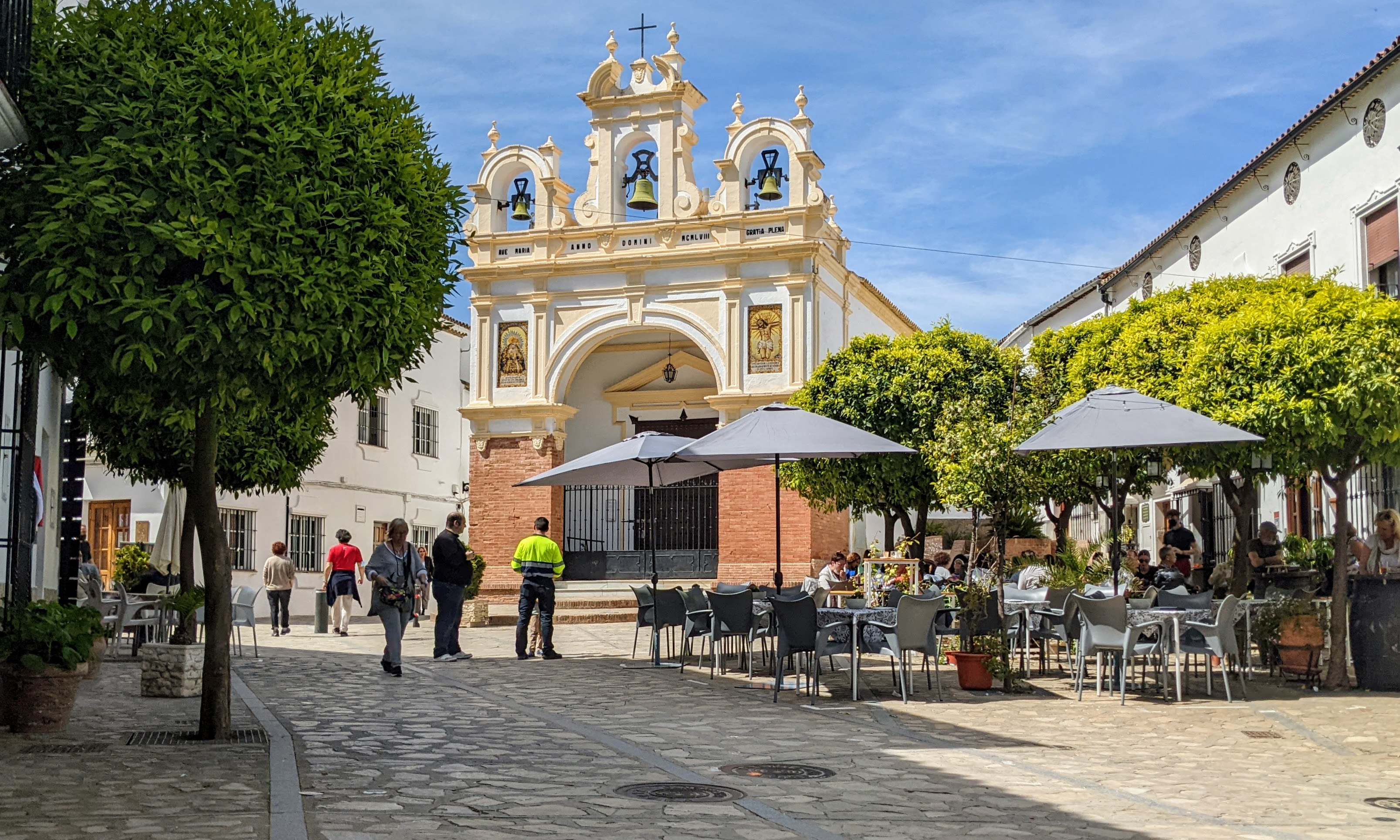
It was on the final leg of our Spanish odyssey, the drive from Ronda to Seville, that we visited the last and best of the white villages: lovely Zahara. Our good friend Karen Hinds told us about this hidden gem, making us promise that we wouldn’t miss it. How right she was! From the moment we wandered into the quaint main square for a late brunch, we knew we had found something special. This was the quintessential European village that has defied the passage of time, a place you wish you could linger in forever and forget all the cares of the world. (Of course, Amy started looking at real estate.)
Needless to say, a castle loomed over the hillside town, though in this case, it was simply one imposing tower, perched precariously on a high cliff. We spent a serene couple of hours walking the trails to the summit, admiring the views and the wildflowers. Inside the tower, we learned about how the town hosts an costumed reenactment each year of the night when the Moors guarding the tower were caught off guard by a cadre of Christian soldiers who had scaled the cliff—a story that seems likely to draw as much from local legend as historical fact.


.jpg)

We were sad to finally depart Zahara several hours later, but it was still a long drive to Seville. Stay tuned!