
Sintra
The magical town of Sintra is so close to Lisbon, and such a common day trip, that some consider it part of the capital. But the vibe is a world apart. A small hamlet at heart, perched in the wooded hills with a view to the coast, with more than its fair share of crumbling castles, spectacular palaces, stunning chalets, and intricate gardens, I wonder whether a single trip here by Walt Disney could have inspired half the fanciful stories and settings he crafted during his lifetime. For centuries, Sintra was the playground of the monarchy and the elite, who built their dream homes here, and today it remains one of the wealthiest postal codes in the country, Portugal’s own Montecito. (Actually, it feels a lot more like Mill Valley, CA.) But unlike those very private enclaves, Sintra is a huge tourist attraction, with tour buses choking its handful of tiny streets most days. But no matter…it’s still charming as hell and well worth a visit.
Amy had arranged another rental car for our trip to Sintra, our third in as many weeks, and had convinced our friends Matt & Nadja to do the same. But I was tired of all the hassle, the expense, and the adrenaline rush of driving in Europe, so this time I vetoed. We’d take public transit instead, I insisted. Which turned out to be a breeze—Sintra is only a 40-minute, €2.40 ride on Lisbon’s commuter rail network, and our apartment there was a 2-minute walk from the station. We quickly learned that driving and parking in tiny Sintra would have been an exercise in frustration—as in most European cities!

Photo from Parques de Sintra
The first thing you notice about Sintra—it’s impossible not to—is the ruin of a Moorish castle (called, well, the Castelo dos Mouros) perched atop an impossibly steep mountain looming over the town. Almost anywhere you go, it seems to be right there above you. As we rolled in, several days of rain were imminent, so we decided to do a quick hike up to these ruins before the trails got all muddy and wet. From our apartment, we zig-zagged up a series of incredibly narrow public roads and driveways until we found an official-looking trailhead. Along the way, we found an old metal door in a stone wall, half-heartedly held shut with a piece of rope. We were surprised when it easily pushed open, revealing the ruins of a tiny old church overlooking the town. Only one small tower remained, and hidden behind tall grass, the kids and I found a narrow spiral staircase, which of course we ascended, to a tiny platform on top of it, now taken over by wildflowers and grasses. How was this here? How had nobody else discovered it? We felt almost like archaeologists!
The trail switch-backed up through what seemed like a quintessentially European forest, made up of broad shady trees and punctuated by large boulders and bits of old stone walls sticking up out of the ground here and there. A small sign informed us that people had lived on this mountain for millennia, as evidenced by ancient granaries and burial sites discovered here. As we summitted, a light rain started to fall, and we discovered probably the most spectacular and photogenic castle ruins I’ve ever seen, something straight out of a scene from Lord of the Rings, with 360° views over the town and out to the coast. But it turns out this was just one of the many treasures Sintra had to offer.


The next day, we walked through a pouring rain to the sprawling Sintra National Palace, which takes up half of the tiny downtown and is visible for miles with its iconic cone-shaped chimneys, the symbol of Sintra and quite possibly the inspiration for Madonna’s brassiere. Its origins date to the Moors in the 8th century. But like so many palaces, it has been added onto for centuries, and walking through its rooms is a journey through those centuries and the lives of a dozen different Portuguese kings & queens. The most impressive of these is the 16th-century Sala dos Brasões, with its huge domed, paneled ceiling, paintings, and tilework. But Amy & Griffin’s favorite room was actually the large palace kitchen, to which the famous chimneys belong. It may not have been the most impressive palace we’ve seen on this trip, but it was fascinating nonetheless and a great place to stay dry!

Photo from Piqsels.com


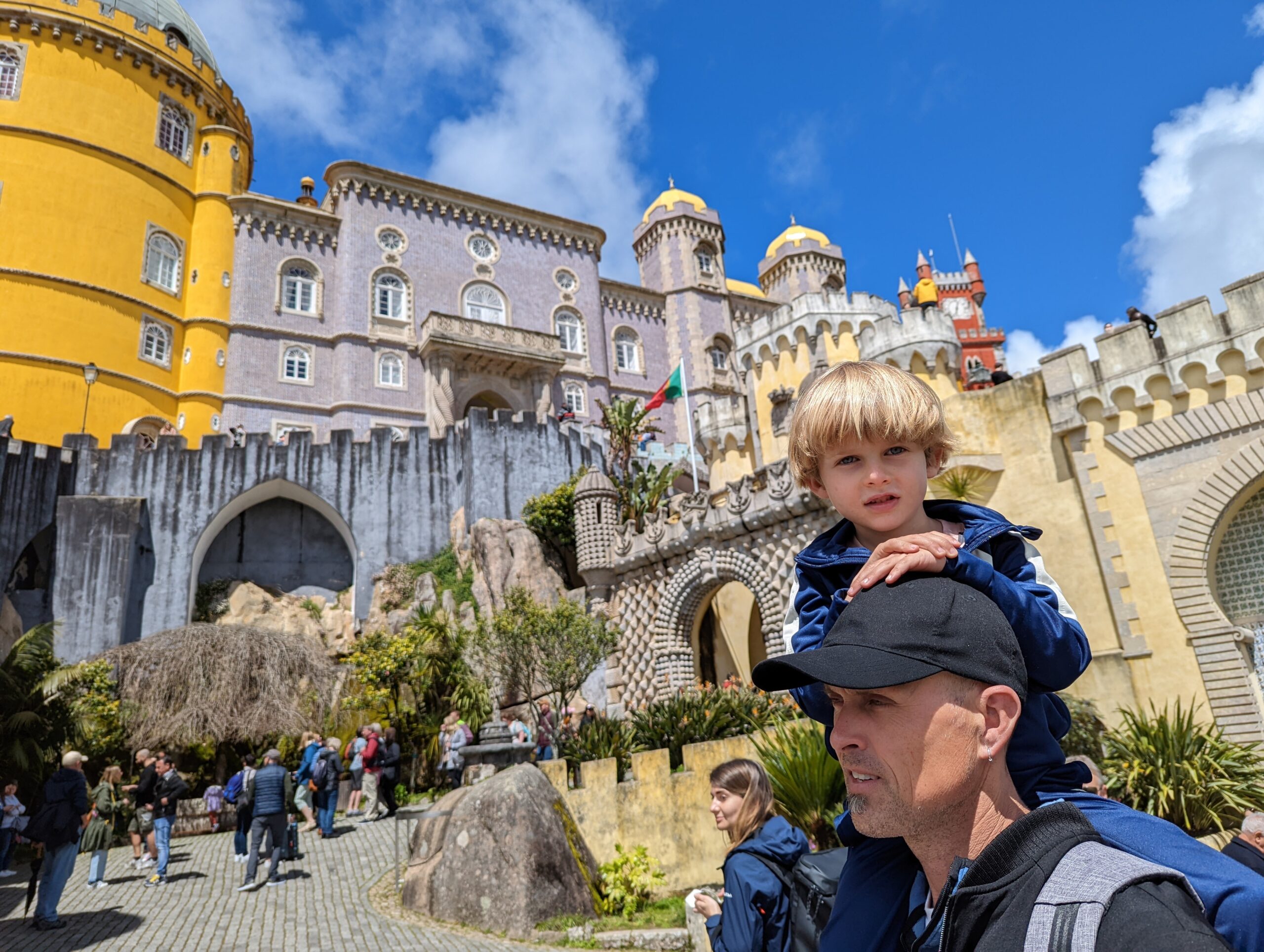
Not content with that palace, King Ferdinand II in 1838 acquired a tiny, ruined mountaintop monastery in Sintra, opposite the Castelo dos Mouros, and turned it into a second palace which makes the Sintra National Palace look drab and homely by comparison. Blending a cornucopia of architectural styles and his own romantic ideas, this fairytale red and yellow castle perched high above the town has been oft compared to Germany’s famous Neuschwanstein Castle, built a few years later. Unfortunately, Pena Palace is no secret, and despite a timed entry system, we were surprised to find a huge crowd of tourists crammed into a single file line marching the designated tour route through the palace, which made it hard to appreciate what we were seeing or to snap photos. But we were still blown away by the incredibly detailed and ornate embellishments of the place. Once outside, we easily got away from the crowds and took our own tour of the 500-acre “gardens”. These are nothing like the well-manicured geometric gardens you’d find in, say, Versailles. This was instead a series of paths, streams, bridges, fountains, and ponds threaded through the mountainous forest, which seems to have largely taken it back again. Some exotic plants, including California sequoias, western red cedars, and ferns from Australia and New Zealand mix with the native trees and undergrowth. We spent probably two hours exploring this secluded and peaceful wonderland, until we suddenly found ourselves at the road, halfway back down to the town.

Photo by Trey Ratcliff on Flickr


Our final adventure in Sintra was a visit to the Quinta da Regaleira, the chalet of an eccentric Portuguese-Brazilian millionaire named Carvalho Monteiro, who apparently made his money in mining. Here in Sintra, he “was eager to build a bewildering place“, full of “enigmatic buildings” and garden features “that allegedly held symbols related to alchemy, Masonry, the Knights Templar, and the Rosicrucians” (Wikipedia). And so he did. While the ornate, palatial home he built here is certainly impressive, it is the 10 acres of labyrinthine hillside gardens that truly delight most visitors. Here we found meandering paths, wide plazas, stone towers, streams, waterfalls, grottoes, and most mysteriously, two “initiation wells”, which “better resemble underground towers lined with stairs. These wells never served as water sources. Instead, they were used for ceremonial purposes that included Tarot initiation rites.” (Wikipedia) At the bottom of these damp, moss-covered spiral staircases into the earth, we found a series of interconnected caves. Another set of caves extended around a semi-underground lake further down the property. (What, it never occurred to you to build a network of caves for secret underground rituals under your yard? How unimaginative of you!) We spent several wondrous hours here wandering the grounds, and were delighted when a friend of Nadja’s & Matt’s, who just happened to be visiting Lisbon that weekend, popped out to Sintra to join us for the afternoon.


After three glorious days here, it was time for a tearful goodbye as Matt, Nadja and EvaBella hopped on an early morning flight back to Germany. The three of us had planned to head north to the famous city of Porto (you’ve heard of Port wine?), but those plans had to be cancelled as we took some hastily-planned flights of our own…