
Tivoli (& Rome)
Our sojourn on the coast of Italy was over, and it was time to move on. We said arrivederci to quaint little Vietri sul Mare and hopped in a cab to Salerno next door, where we had an hour or two to grab a coffee and explore before catching our train. (Salerno: meh. Nice enough, but don’t waste any time here when you could be exploring the Amalfi Coast!) Before long, we were whizzing along to Naples and then onto Rome, once again admiring the gorgeous countryside in between from the window of our comfy high-speed train. Aaahhh…
But we weren’t leaving Italy just yet! Amy’s sister was meeting us in London in about a week, leaving us a few days to kill in Rome in between. And while there is always more to do and see in Rome…we felt like we’d done a pretty good job covering it just a few weeks earlier. So to beat the heat and see something new and different, Amy was taking us somewhere else, somewhere special, for a weekend trip just outside the city: Tivoli.
Sound familiar? Perhaps that’s because there are dozens of places named Tivoli. I knew of the wonderful theme park in Copenhagen. It’s also the name of the grand city park we visited in Ljubljana, Slovenia…and lots of other parks, towns, and even buildings around the world. But the original Tivoli, the legendary one for which all the others were named? Turns out that it’s a sleepy little town an hour outside Rome that almost nobody has heard of and nobody goes to. There is no high-speed train there. In fact, the train to Tivoli was easily the shabbiest, most antiquated thing we’d ridden in all of Italy. (Griffin quickly discovered that the toilets were simply holes that emptied directly onto the tracks.) For the first half hour, the thing never got over 20 mph, and I wondered whether it was because it simply couldn’t. But it picked up steam once we got up into the hills. When we finally did arrive, we stepped out into a tiny provincial train station that seemed almost deserted. We were on the side of a small mountain, surrounded by brown, dry, rocky hills, and below us, there was a river with a tangle of trees on each bank. Past this, on the opposite hill, the roofs of a small town were visible. Where were we exactly? And how did this backwater inspire dozens of copycat Tivolis?
We had been told that it was an easy walk from the train station over the river to our hotel. And perhaps it is, if you know where you’re going and aren’t hauling a year’s worth of luggage! We spent the better part of a hot, miserable hour lugging our stuff over a rickety old bridge, up hills, across busy roads, down dead-end streets, and over endless cobblestones, until we finally found it. And once we did, we could hardly believe that we were at the right place. Amy had told me she had splurged on this one. Instead of an Airbnb, we were staying in a 16th century palace that had been converted into an upscale boutique hotel, the Residenze Gregoriane, complete with its own Roman baths. But, um, that’s not exactly what this looked like…at least from the outside!
It was the right place, and once we found our way through the rickety street door into the courtyard, we were greeted warmly by a gracious, attractive young woman, who sat us at a table and got us some cold drinks. At another table, an older Italian gentleman sat quietly smoking a cigarette, but otherwise, we were alone. The young woman confirmed that this was in fact a 500 year-old palace, the Palazzo Mancini Torlonia, most famous for this courtyard, which had been richly adorned with bas-relief scenes on the walls. In its heyday, the palace had supposedly hosted two popes, and—according to something we saw framed on one wall—the Austro-Hungarian Empress Sisi? But then the place had slowly declined and then sat vacant for many years, until it was purchased by a lawyer—the quiet man sitting opposite us in the courtyard—who had spent the last few decades painstakingly restoring the crumbling palace, mostly by himself. But I guess he hadn’t gotten to all of it yet, and he still had a few years of work to go, particularly on the exterior! Nonetheless, he had opened it as a hotel, boasting just three suites, and we were staying in the nicest of these—the Superior Suite.


If the hotel was underwhelming at first, we quickly forgot about it once we were arrived at our suite, which truly was palatial. The first room, a massive parlor, must have been at least 25′ square with a ceiling at least 14′ high. It was lined with leather couches, a large table, and lots of other ornate furniture, a vintage hi-fi system and…an old wooden foosball table! The bedroom was smaller but just as tall, with a 4-poster bed that looked almost diminutive in the center of the room. The far end had been split into two levels, with the bottom a small bathroom and changing area, and the upstairs an open seating area adorned with an old gramophone and accessed by a dainty glass & steel staircase. The whole place felt more like a museum than a hotel room, and we were almost afraid to touch anything, much less set our 6 year-old loose in it!
But before we could settle into our room, we headed down to the “Roman baths“, located in some of the vaults under the building that overlooked the river. We learned that these were not original, but had been built from scratch from what had once been a paper mill (no doubt similar to the one we had toured in Amalfi). It was a sprawling and elegant complex, dimly but tastefully lit, and we had them all to ourselves. With steam wafting through them and a few masseuses to give you a good rub-down, it would have been the pinnacle of luxury. But it was just us, and for whatever reason, the hot baths weren’t operating, so we had to make do with splashing around in a cold pool…so we didn’t stay too long. Oh well.


The hotel had yet more surprises, including a wonderful, cozy little bar and dining room, where we enjoyed a fancy breakfast the next morning, as well as some cocktails Saturday night, after Griffin had fallen asleep. Mixed by the proprietor himself, I can easily say that it was the best Negroni I had in all of Italy! We would have liked to have talking with the gentleman more, if only he spoke more English or we spoke Italian. Instead, we spent close to an hour chatting with a friendly young man who worked for him, one of a handful of dedicated staff members who ran the place. If Italian men have a reputation for being cocky or arrogant, this guy was anything but—he reminded me of a grown-up version of the title character from the Pixar film Luca—and we enjoyed peppering him with questions about his life and what he did for fun, which he seemed happy to answer.
We had only a Friday & Saturday night in Tivoli, which meant only a day and a half to explore. Turns out it was hardly enough for this amazing little place. Tivoli in an ancient town, so old that its origins are based on legends rather than evidence. Originally called Tibur, it was once an ally of Rome, until Rome conquered and absorbed the town in 338 BC. Known for its wonderful views over the Roman campagna (countryside), its good water, and its natural beauty, Tibur became a resort town for prominent Romans, many of whom built villas here, including the Emperor Hadrian. (The remains of this villa are one of the three main attractions, but we skipped it due to lack of time and having had our fill of ruins.) Over the next couple of millennia, a lot happened here—but for once, I won’t go into the details, which you can skim on Wikipedia. Suffice it to say that Tibur had a much more eventful history than its size would seem to warrant, due in part to its strategic location, and the Tiburtini (as the residents are still known) maintained a notable amount of independence from would-be rulers and were no slouches when it came to defending their fair city.
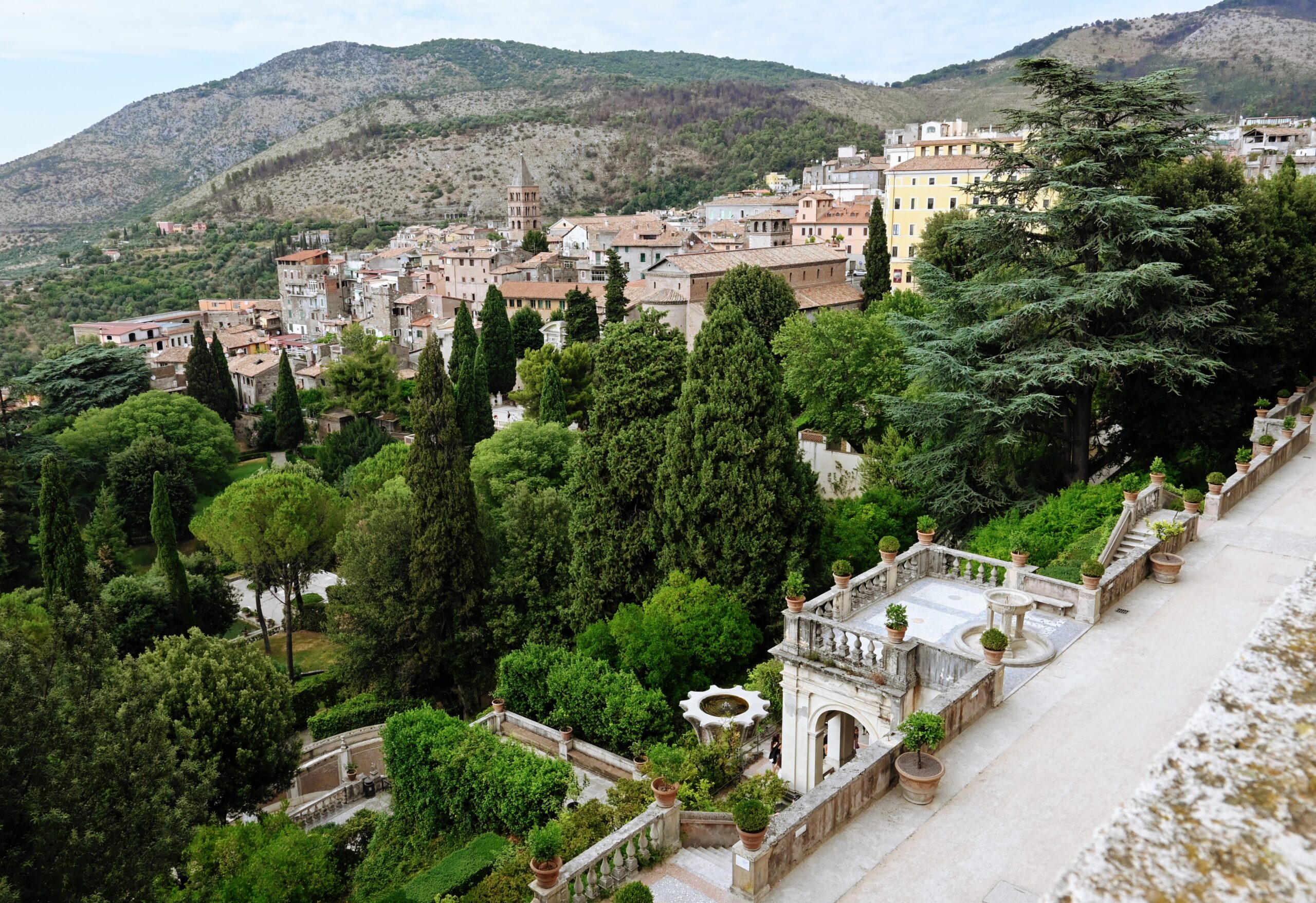
Fast forward to the Renaissance. Back under the sway of Rome, popes, cardinals, and other elites invested significantly in the town, building many villas such as the one we were staying in. But the greatest by far is the Villa d’Este, constructed in 1550 by the uber-wealthy Cardinal Ippolito II d’Este (apparently as a consolation prize to himself after he was not elected Pope). Now an Italian state museum and a UNESCO World Heritage Site, his richly decorated palace and sprawling gardens required razing or repurposing a significant portion of the town (over 11 acres, to be exact). It also required the construction of some lengthy underground tunnels from the river to feed the garden’s spectacular water features, which include “an amazing concentration of fountains, nymphaea, grottoes, water themes and a organ which produces audible effects created by water” (Villa d’Este official website). Tivoli is perched on top of a mountain, so it took some creativity to convert the unruly topography into such a massive garden, but the architect, Pirro Ligorio, used it to his advantage, creating a terraced layout, and designing all the fountains (50 of them, plus 255 waterfalls and 100 pools) to be gravity-fed, one after the other, before the water is returned to the river downstream. We were blown away by all these ingenious water features, especially the magnificent centerpiece Fountain of Neptune, the almost-as-impressive-but-often-overlooked Oval Fountain, and the Hundred Fountains, which are actually almost three hundred spouts shaped like animal heads fed by three terraced canals, that stretch nearly the length of the gardens. This 3-minute drone footage is a great way to appreciate the grandeur of the place, or head to Wikipedia for even more photos and details.
We were less impressed with the Villa d’Este palace, which was basically a long strip of rooms slathered from floor to ceiling with overwrought frescoes, which we found fairly forgettable (especially after seeing things like the Vatican and Borghese Gallery in Rome). But the grounds…then as now, they are considered a masterpiece, said to have inspired palatial gardens for centuries afterwards, including Versailles itself, and more recently, they’ve been used as a backdrop for myriad films and commercials. Rightly so. But upon closer inspection, we couldn’t help but notice how poorly maintained it all was, with dead spots in the lawns, weeds everywhere, and algae choking the fountains. We said as much to a jovial group of Spaniards we met there, and they agreed that they were horrified at the state of the place, and that it should be an embarrassment to the Italian government. It was yet one more example of my love-hate relationship with Italy: so much brilliance, tarnished by a lackluster effort to keep it up. (And when a Spaniard calls you out for being lazy, that’s something indeed!) Sigh.


Outside the villa, the town itself proved to be similarly unkempt—but ridiculously charming. Though not quite so tangled as those villages on the Amalfi Coast, it was nonetheless a wonderful maze of narrow medieval streets threading up and down between crumbling, leaning, centuries-old buildings. It all seemed surprisingly serene for a summer weekend, until we popped out onto the main pedestrian street, the Via Trevio, where we found a buzzing scene of restaurants and bars, reaching a crescendo at the Plaza Giuseppe Garibaldi. A great place to spend Saturday evening getting some cocktails and light bites while watching the town go by. We also enjoyed exploring it by day when it was considerably more quiet, wandering around lazily with a gelato in hand.
But in my opinion, Tivoli’s greatest asset by far is not man-made. I mentioned the river a few times, and no description of Tivoli is complete without a lengthy aside on this river, the Aniene. When we arrived Friday afternoon, all we saw of it was a lazy wide channel below the train station, lined with disheveled trees and choked with reeds and looking almost stagnant. Griffin and I followed it Friday afternoon, to where it appeared to stop abruptly at something that looked like a dam, except that it was built into a hillside, not across a valley. Strange. Across the road and at a right angle to this structure, the river reappeared, but significantly diminished, so much so that part of its channel was being used as a town parking lot. It then did a lazy bend, went off a timid little waterfall, and meandered out of view. Nothing very impressive. It wasn’t until I did some more research that night, and some more exploring the next morning, that I appreciated what was going on here—and realized how close we were to missing Tivoli’s most impressive feature.
You see, the town was built on a hilltop next to the river, but not at so great an altitude above that it was immune to the river’s occasional flooding, which caused significant damage throughout the millennia. What we weren’t able to appreciate until we saw it first hand was that on the north side of town, both town and the river come abruptly to a staggeringly tall cliff, where the river plummets 160 meters down into the Valle dell’Inferno—the Valley of Hell. (I don’t know what it’s called this—it’s a beautifully lush chasm.) But the river doesn’t descend there in a nice long ribbon, as you might imagine. Originally, it got there by a series of four falls, but after various floods, particularly in 1826, it altered its path. Today, just before it reaches the cliff edge, the river suddenly disappears underground into a chaotic, Swiss-cheese-like, sun-lit cavern called Neptune’s Grotto, spews out of the cliff in a small cataract down to a turquoise pool set on an Eden-like terrace, meanders a bit, disappears underground again, then issues forth in a second waterfall that leaps to the valley floor. All together, this pair of waterfalls has to be one of the most jaw-droppingly gorgeous creations of nature that I’ve ever laid eyes on. Apparently I’m not alone; the beauty of this waterfall has drawn people to Tivoli for millennia, including privileged young Europeans on the Grand Tour, and has inspired countless paintings and poems. In fact, this place is so revered that two ancient temples were built at the lip of the falls, one to Albunea, aka the Sibyl of Tibur, a water nymph who was worshipped here as an oracle. Luckily, unlike many of the town’s oldest buildings that were washed away in the floods, a significant portion of these temples remain intact.
Earlier tourists did some pretty precarious things to enjoy all this—including being lowered into Neptune’s Grotto by ropes. Nowadays, it’s all much easier to access and appreciate since it was incorporated into a fairly vertical cliffside nature park called Villa Gregoriana, commissioned by Pope Gregory XVI in 1835. We explored this on Saturday morning on an extremely pleasant (if hot and tiring) hike, following the winding paths and staircases from one eye-popping vista to another, exploring the ruins of an old Roman villa and a much newer tunnel cut into the cliff face, and even climbing up inside Neptune’s Grotto from a narrow staircase below. It was magnificent. The park certainly wasn’t empty, but we were surprised how few tourists had found their way here, when we knew Rome just a few miles away was absolutely mobbed with them. Their loss!


But there’s more—I’m omitting the final wonder of Tivoli: a second, man-made waterfall, the Cascata Grande. After the floods of 1826, everybody was pretty fed up with the temperamental Aniene. Pope Gregory got involved and held a design competition to come up with a solution. The winning entry involved digging two tunnels to divert most of the river’s water around that last bend of the river in the old town, where it is now constrained to a much more disciplined flow. Remember the strange dam-like structure that appeared to be built into a hillside? That’s the start of the tunnels. Shaped like guitar picks, they terminate in a sheer cliff face directly, where the water shoots out and plummets 120 meters to the floor of the Valle dell’Inferno, a few hundred meters downstream from the original falls. Though certainly not as lovely, this dramatic artificial cataract is still quite sight to behold, either up close from the viewing deck at the Villa Gregoriana, or from across the valley on the train ride in—where it is much more obvious to casual observers than the more clandestine natural falls. (Most probably don’t even realize there is another waterfall!)

Photo from Fondo per l’Ambiente Italiano ETS
There is more to see in Tivoli—Hadrian’s Villa, the temple complex of Hercules Victor, and the castle of Rocca Pia, to name just a few—but we felt that we had gotten in the highlights. If you happen to visit Rome anytime soon, be sure to bundle in a day trip to Tivoli if you can. It would be criminal to bypass this wondrous place, and you get a lot of bang for your buck here: gorgeous natural wonders, gardens that far surpass anything in Rome (or probably anywhere else in Italy), plenty of important ruins, and a charming small town vibe. It’s a nice complement to the sometimes overwhelming grandeur of Rome.


Speaking of Rome…by Sunday, it was time for us to head back there, where we would spend a final couple of days. Our plan was to meet up with two Santa Barbara friends, Rachel and Fannie, share an apartment, and do a little more exploration together before we flew out for London on Tuesday. But Fannie came down with COVID a few days before, so we quickly rejiggered plans and got our own place—a painfully hip bachelor pad in a shockingly quiet corner of town, not far from the train station. (Most importantly, it had great A/C, since Rome was even hotter than usual at over 100° F!) That evening, I headed out solo to meet up with our Santa Barbaran-turned-Roman friend Lindsay one more time at her rooftop wine bar at the Hotel Nainer, where she and I, along with her beau Alessandro, his fascinating mother, and another mutual friend from Santa Barbara (they’re everywhere!) got deep into some lively, drunken conversation until after midnight.
The next day, Amy, Griffin, and I met up with Rachel—who had never tested positive for COVID—and did a leisurely walking tour of central Rome, revisiting some of the places we had been a few weeks earlier, including the Plaza Navona, Pantheon, Trevi Fountain, and Spanish Steps, but at a more relaxed pace.


Then Amy and Rachel jetted off to the airport together. Because at some point on Sunday, Amy had suddenly realized that there was a very important European cannabis conference happening in London Tuesday & Wednesday that she absolutely had to be at. (If she read her emails a little more diligently, she would have known about it months in advance. But…this is Amy!) So against my protestations, she booked a last-minute flight to London on Monday night—the same one Rachel was already on—so she could catch both days of the conference. Grudgingly, Griffin and I spent our last night in Rome alone, then followed behind on Tuesday morning, as originally planned, lugging most of our stuff. But how can I complain when Amy’s job (and cannabis is, um, her job) is financing this trip?
Stay tuned for the account of our fantastic week in London!