
Slovenia
Pop quiz: where the heck is the country of Slovenia? Can you find it on this map of Europe?

First hint: it’s not Slovakia (which Amy kept calling it while we were there!)
Second hint: it’s the northernmost country that resulted from the breakup of Yugoslavia in 1991–1992.
Give up yet? It’s that little chunk of green bordering the northeast corner of Italy.
And what an appropriate color for this verdant paradise! Heading south from Graz on the train (see our itinerary to the right), we quickly crossed the border into Slovenia, but nothing changed about the topography. Much like Austria, it’s lush and green, a combination of forests and meadows blanketed over a jumble of hills and mountains. In fact, nearly 60% of the country is forests, though that number actually seems low to us! I recall once hearing it called the garden of Europe, which seems like an apt title. Our train followed first the Mur River, then the Sava, through beautiful canyons. We were surprised to discover that both rivers and most of the country (like most of southeastern Europe) drains into the Danube and the Black Sea. That’s because most of Slovenia tilts up towards the Julian Alps, the southeasternmost corner of the Alps range, which splits the watersheds just before the Adriatic.
Slovenia is a wonderful little place, still unknown to almost everybody. As a country, it has only existed since 1991; as an idea, seems it’s only been around since the 1800s. Slovenia was a state of the former country of Yugoslavia, which existed from 1929–1992, and before that a part of the Kingdom of Serbs, Croats & Slovenes, which existed briefly after WWI.
Slovenia has historically been the crossroads of Slavic, Germanic, and Romance languages and cultures. Its territory has been part of many different states: the Roman Empire, the Byzantine Empire, the Carolingian Empire, the Holy Roman Empire, the Kingdom of Hungary, the Republic of Venice, the Illyrian Provinces of Napoleon’s First French Empire, the Austrian Empire, and the Austro-Hungarian Empire.
Wikipedia

Wikipedia
After all that, it must be nice for the Slovenes to finally have their own country. But who are the Slovenes? Great question. They’re one of several distinct Slavic groups in this part of Europe. (In fact, “Slovene” comes from the word “Slav”.)
Okay, but who are the Slavs? I realized I had no idea, so I spent a good amount of time on YouTube trying to figure it out (this 10-minute video was particularly helpful). Apparently, the Slavs originated in the steppes of Russia and the Ukraine, a largely nomadic people. They were repeatedly pushed around and enslaved by many of the belligerent groups around them—our word “slave” actually comes from “Slav”. But the Slavs pushed back, and around the 5th century AD, started migrating out in every direction. Today, they’re the largest ethnolinguistic group in Europe. By far the biggest and most successful are the Russians, but almost all the countries of eastern Europe, including Ukraine, Belarus, Poland, Romania, Bulgaria, Czechia, Slovakia, Croatia, Serbia, Bosnia-Herzegovina, and Slovenia, are predominantly populated by descendants of these Slavic people. (Large numbers also immigrated to North America. Perhaps your ancestors are Slavs? Amy realized that many of hers were.)
But calling all these diverse people “Slavs” masks some considerable differences between them, including language and religion. Slavic peoples and languages are typically categorized as Eastern (e.g. Russia, Ukraine), Western (e.g. Poland, Slovakia), and Southern (e.g. Slovenia, Croatia, Serbia). Yugoslavia, which literally means “south Slavic lands”, represented an attempt to unify the various groups living along the Adriatic. But a messy union it was, held together by the sheer will of strongman and president-for-life, Josip Broz Tito. That story starts in 1941, when German, Italian and Hungarian forces invaded Yugoslavia and divided it. But a fierce resistance formed to this occupation, led by Tito, that eventually expelled the Axis powers with only limited help from the Soviets. A new Communist state of Yugoslavia was created, again led by Tito. After a break with the Soviets in 1948, the country charted its own course, separate from the USSR and the countries behind the “Iron Curtain“—no easy task!—and co-founded the Non-Aligned Movement (Rick Steves has a good, short discussion on this is his great video on Slovenia.)
Tito died in 1980, and ethnic tensions and economic problems eventually tore Yugoslavia apart a decade later, at about the same time that the Soviet Union was also collapsing. Slovenia was one of the first Yugoslav states to agitate for independence, starting in 1987 and succeeding in 1991 with minimal violence. But further south, things did not go so smoothly, especially between ethnic Serbs, Croats, and Bosniaks, resulting in a bloody and complicated war that I remember from my twenties but understood absolutely nothing about—and which still seems like a confusing mess even now. I suppose I’m not the first outsider to be confounded by the as-yet-still unresolved conflicts in this area we call the Balkans. (Strange term, since the Balkan mountains are actually in neighboring Bulgaria.)
Enough about that. Slovenia today is a quiet, peaceful, and surprisingly homogenous country of 2.1 million people who are almost entirely ethnic Slovenes and Catholics and speak—what else?—Slovenian. While diversity is surely a good thing, it’s also true that homogeneity makes it easy to identify with your countrymen and work towards common goals. And of all the former Yugoslav states, Slovenia has probably been the most successful and prosperous, which is most evident in its capital city, Ljubljana, where we stayed for nearly a week.
As we boarded our train in Graz bound for Slovenia, we weren’t sure what to expect. First off, it wasn’t one of the slick, shiny Austrian trains we’d be enjoying; it was a Slovene one, and by comparison, it seemed like a oxidized relic, each car made up of those old-fashioned seating compartments linked by a narrow side passageway, like you see in Harry Potter films. (Did I mention there was no AC or WiFi?) Were we going back in time?
Not at all. As we pulled into Ljubljana (pronounced “loob-lee-yawn-ah”…we think!) a couple hours later, we were surprised to find that it is a thoroughly modern and flourishing place. Rows of handsome old apartment buildings, probably left over from its days as part of Austria, mix with a handful of drab communist blocks, a few slick high-rises like the Intercontinental Hotel, and lots of brand new glass-covered condos that are going up around the city’s perimeter. Scads of hybrid buses cruise the well-maintained highways and roads. Protected bike lanes are everywhere and well used, as are the city’s own bikes, which you can rent with your smartphone. We also spotted a half-dozen public car charging stations. A few tree-lined parks, well-appointed with playgrounds, grace the city center, while vegan eateries are more plentiful than in many American cities. And how clean it all is! Ljubljana won the EU’s coveted “green capital of Europe” award in 2016 for its environmental leadership. We loved the many mature trees that line the streets, especially in our neighborhood, and the cacophony of bird sounds that started at dawn each morning outside our windows. We adored our spacious 2-bedroom AirBnB, which was in one of those older apartment buildings, but had been completely remodeled with modern appliances, furniture, and art, making it every bit as stylish and well-appointed as an upscale apartment in California—for a fraction of the price. While Ljubljana may not be as gilded, manicured, and architecturally harmonious as Vienna (few cities are!), there is nothing at all backwards about the city. On the other hand, it has a quaint charm and lack of pretense that few other European capitals can claim.


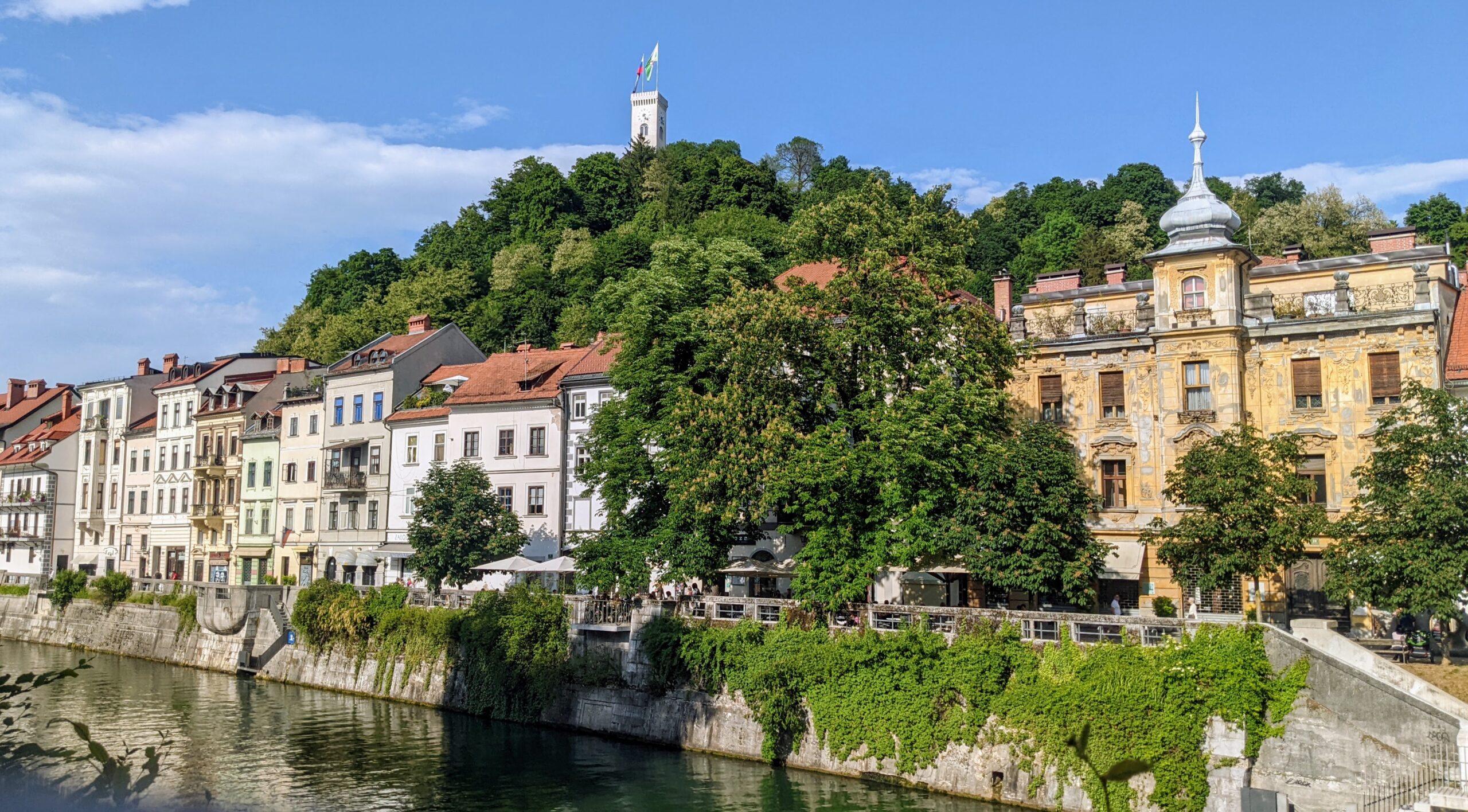
We immediately fell in love with its gorgeous, medieval city center, situated around the lazy, tree-lined Ljubljanica River. Of course, a steep hill rises in the middle, crowned by a castle—you know the recipe by now—but the real attraction is the handful of narrow cobblestoned lanes tucked between the hill and the river, lined with centuries-old buildings occupied by adorable cafes and shops. Cars are prohibited; only pedestrians and bicyclists share these lanes, and all the well-used bikes leaning against shop walls made for some charming photos. At the center of it all is a bright red church presiding over a small square and a truly unique triple bridge, designed by Ljubljana’s beloved architect, Jože Plečnik, who oversaw most of the beautiful improvements made a century ago, including the arcades along the river. The night we arrived, the bustling summer Friday night food market was already well underway, where enthusiastic restauranteurs, winemakers and brewers set up booths next to the cathedral to hawk their wares. We gorged on yummy local wine and beer, an out-of-this-world vegan burger, a falafel plate, and some ridiculous cream puffs. As we sat amongst the crowd and enjoyed the vibe, I felt a giddy sort of joy well up in me for the first time on this trip. There was something really special about this place, and I felt so lucky to be here. Was it true love?
Over the next six days, the four of us (my mom was still with us) spent quite a bit more time exploring the city center, meandering the lanes and squares, enjoying a relaxing boat ride on the river, venturing up the funicular to the castle during a cute “Castle Days” event, and relishing several excellent meals. But since we had the time, we also rented a car and ventured outside the capital to some of Slovenia’s other treasures—which is a piece of cake because it’s a small country well connected with lovely modern highways. (They say you can see a third of the country from the capital on a clear day!)
Here are some of our favorite memories and adventures from our sojourn in Slovenia:
Swooning over the impossibly perfect, aquamarine Lake Bled in the Julian Alps. While it has an impressive castle (dating from 1004?) perched high above it on a cliff, the real attraction of this storybook lake is a tiny island crowed by an old church. Small flat-bottomed wooden boats called pletna ferry passengers across the serene lake to the island, paddled by standing oarsman whose families have been doing this for well over two centuries. (Motorized boats are not allowed.) Tradition has it that if you take the boat ride out to the island, climb the 99 steps to the church, and ring the bell three times while making a wish, your wish will be granted. We did that of course—though Griffin needed some help, as his fully body weight wasn’t enough to ring the bell!—but also enjoyed walking the 6 km perimeter of the lake, which seemed to get ever more photogenic with each turn of the trail. Tito apparently loved this lake so much that he built his presidential palace here, now an upscale hotel.

Photo by Walkerssk on Pixabay


Hiking Vintgar Gorge, just above Bled. Somehow this fantastically gorgeous river canyon, which includes Slovenia’s highest waterfall, was not explored until the 1890s. Precarious wooden walkways have been attached to the sheer rock walls, allowing visitors to follow the Radovna River through the canyon. Almost equally beautiful was the hike back out, past an ancient pilgrim church and through green sheep pastures, where we enjoyed spectacular views over the Bled area and some small villages, and had a brief visit with a young horse and his parents.


Descending into the jaw-dropping Postojna Cave, which the Slovenians proudly proclaim the queen of all caves. The country’s limestone karst landscape is riddled with caves and sinkholes, but the 15 km Postojna Cave complex is something unique and special. I’ve seen many caves in my life, but I don’t recall anything so stupendous as this. The place is so extensive that you can’t walk it all, so a small open-top train was installed in 1872, and an updated version still takes visitors on a 3.7 km loop into the caves to start the walking tour. Meanwhile, the vast “concert hall” gallery at the end of that tour supposedly has space for 10,000 people! On the way out, you’re suspended above the Pivka River that made all this, which in most places has now descended into channels far below the caves we were in. Several new species of cave-dwelling creatures were discovered in these caves in the 19th century, most famously some tiny, white, blind, gecko-like creatures called olms, which are the mascots of the caves and affectionately referred to as baby dragons. We got to see some in a dimly lit aquarium during our tour.


Hiking the vast Tivoli Park, which transitions from a traditional city park into a forested hills, not unlike the Santa Cruz mountains. We were surprised to find a rustic exercise course back in the woods, where one of the stations was a pile of logs that you were supposed to squat and lift. I joked that this was the way that Slavs worked out, and was impressed to see that Amy was strangely skilled at this task, betraying her hearty Slavic roots!
Enjoying an al fresco lunch at an upscale eatery in old Ljubljana that specializes in vegan versions of classic Slovenian dishes. My personal favorite was the dessert prekmurska gibanica (say that ten times quickly). We’re lucky we sat down when we did, because minutes later, a brief summer thunderstorm drenched the city and everyone caught out in it, as we huddled under a wide umbrella enjoying our wine and desserts!
Playing at Ljubljana’s water park, Atlantis, where we splashed around in warm indoor wave pools and artificial rivers alongside plenty of local kids and adults. Griffin was ecstatic to ride the two enclosed waterslides (after he was denied entry to the slide in Graz), which both he and I shot down close to a dozen times!
Wandering through the Metelkova Art Center, a former military base in downtown Ljubljana that has been taken over by artists and turned into an outdoor gallery of street art and some large installations that would be right at home at Burning Man.


Buying (and sampling) fresh fruits & veggies from the produce & flower market that happens six days a week in one of the city’s main squares. I guess we shouldn’t have been surprised just how much food Slovenia grows. The cherries were particularly delicious!
Finding ourselves in the middle of national volunteer week festivities in the central square. As we meandered past booths set up to encourage people to learn CPR and contribute to various other causes, some enthusiastic young organizers roped us into a group game where a dozen people, each holding the ends of a web of strings, struggled to work together to pick up and stack a series of wooden blocks into a precarious tower. We were ecstatic when we helped finish the stack!
I’ve speculated before on this blog about the virtues of being a small, unimportant, and out-of-the-way country. In America, we’re used to telling ourselves that we’re exceptional, important, and the best at everything, and presume that we can and should lead the world economically and politically. Any challenges to this status quo are not taken very well. It’s a strange sort of national narcissism. Countries like Slovenia (along with Portugal and my home country of New Zealand) have no such delusions of grandeur, which I believe frees them up instead to focus on their quality of life, without the burden of their own or anybody else’s expectations of what they should be or do. At least that’s the impression I got amongst the Slovenes, who generally seem to be a pretty content people and were always happy to meet us.
But they also have different, possibly more nuanced views on things. It was a cab driver who got us thinking about the Ukraine conflict in a new way, suggesting that it was provocations by the U.S. and NATO that were largely (though certainly not entirely) to blame for the Russian invasion—a viewpoint he correctly identified as being almost totally omitted in American media. I did some more research after that conversation and learned that there was a lot I didn’t know which seemed to corroborate what he’d said. Here, I thought I was a fairly well educated and sophisticated Californian, but it was a Slovenian tax driver who seemed to have a better grasp of what was actually going on in the world. One more benefit of living in a small, independent nation with no international agenda.
We were quite sad to leave to Ljubljana. After gushing over how much we loved Portugal, we were suddenly wondering whether Slovenia might not actually be an even better place to come stay—or even live—someday. (Though Slovenian would be at least as hard to learn as Portuguese!) But for now, we’re keeping this undiscovered gem to ourselves, so do us a favor and don’t mention it to anybody, would ya? 😉
Next stop: Italy!


