
Graz
After our extended sojourn in Vienna, it was time to make our way southwest towards Rome, where we would meet Amy’s parents in a few weeks. But there was so much to see in between in this fascinating corner of Europe! So off we went, boarding a lovely, modern train in Vienna (electric, like every train we’ve been on so far in Europe) for the 2½ hour journey to our next stop: Graz, Austria.
As we headed west, I was surprised how quickly the Viennese suburbs faded away as we started ascending the Alps. And how breathtakingly beautiful they were! In my last post, I mentioned the imagery we probably all have in our minds of the Austrian countryside inspired by movies like The Sound of Music. You know, imposing mountains thrusting up from dense forests and blue alpine lakes, velvety green hills dotted with wildflowers, and tiny white churches, adorable chalets, and an occasional castle tucked in between? Yup, turns out that the Austrian Alps are exactly like that, only more gorgeous than you can imagine and painted in more shades of green than you knew existed! As the train climbed persistently, following rivers, winding around mountains, and plunging through more tunnels than I could count, we tried to capture the scenes we witnessed from the (rather dirty) windows—and utterly failed. So, dear reader, I will resort instead to including this image from a slightly different part of Austria (Lake Almsee) to attempt to convey some sense of the landscapes we beheld on that ride.

It’s like that.
As we reveled in all this unspoiled alpine loveliness and wondered how it could all be, Amy told me that Austria was Europe’s most environmentally sustainable country. At at least according to this glowing article, that seems to be correct:
[The] country of Austria is considered to be the environmental flagship of Europe. Based on the principles of the famous Austrian researcher and anthroposophist, Rudolf Steiner, the first organic farm dates back to 1927. Today, Austria is Europe’s “organic champion” with the highest share of organic farming (19.4% of the agricultural area).
As early as over 200 years ago, the principle of sustainable development in Austria was introduced by the forestry scientist Georg Ludwig Hartig. This principle, which is still in use today, meant that for every tree logged, another tree was to be planted. Today, 48% of the Austrian countryside is covered by forests and the average annual increase in forest acreage over the last 50 years has exceeded 12,000 acres.
“Austria – the Green Heart of Europe”
Hans Kordik in The New Austrian, 2011
The article goes on, but you get this point. The Austrians have a beautiful country, and apparently they’re determined to keep it that way. How novel.
After a while, our train turned south towards the Adriatic and started descending again. We passed through numerous small villages while following the Mur River, until suddenly, the hills opened up and we found ourselves in a valley, smack in the middle of Austria’s second largest city. Graz is not well known to tourists, at least not nearly so much as spots like Salzburg or Innsbruck, so we were a little off the beaten path here. But that’s just fine, because our goal is not just to see the iconic, postcard-worthy places (no shortage of those!), but also to experience the more ordinary and authentic sides of these countries. Places like Graz.

Photo by Ralf Roletschek on Wikipedia
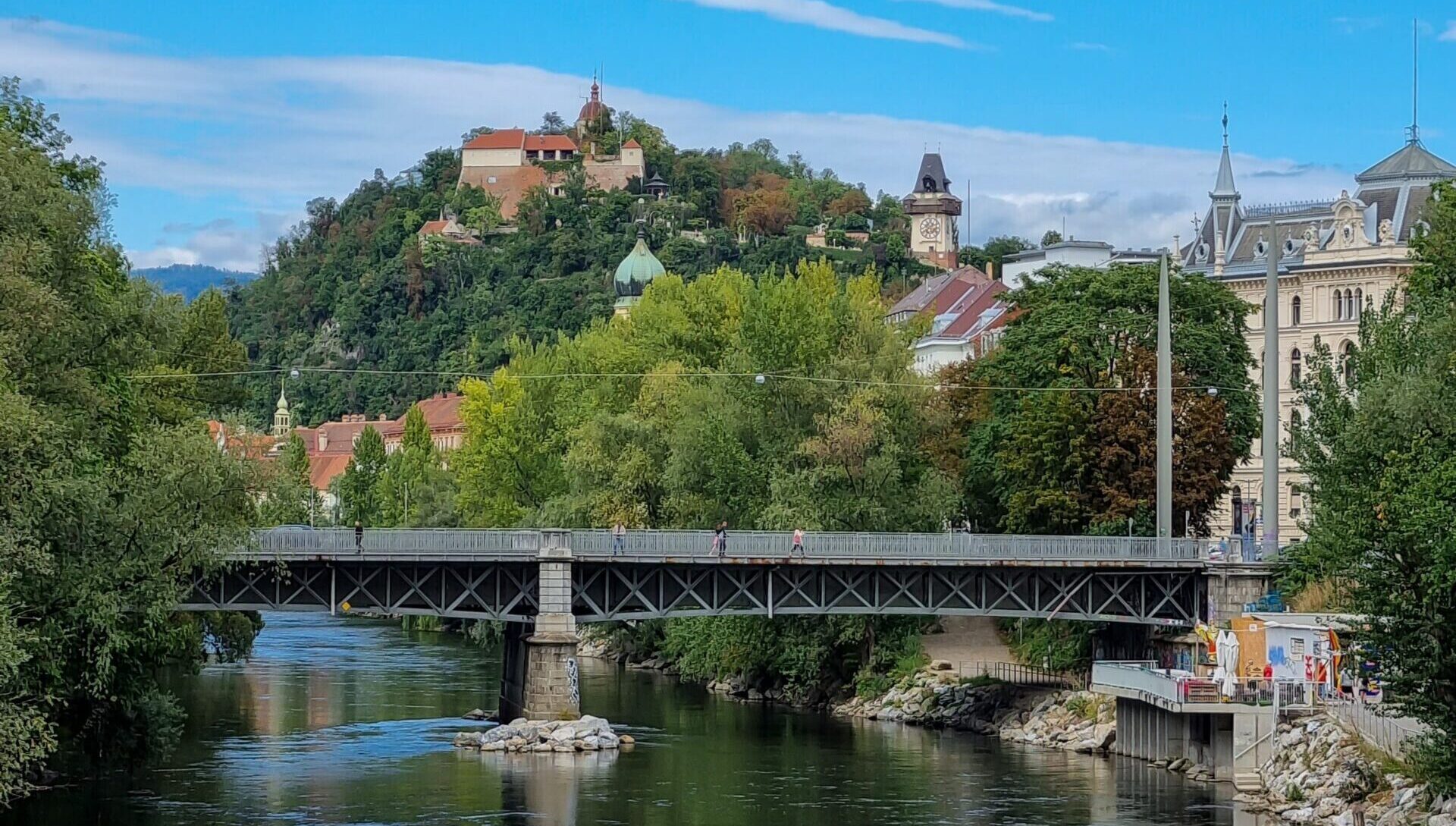
The city’s name derives from the Slavic word for castle, because, like so many places we’ve now visited, it used to have a rather prominent one—on a prominent hill in the middle of town overlooking the river, again like so many other places we’ve visited. (Medieval Europeans were pragmatic, if not original.) Though the castle is now long gone, that hill, known as the Schlossberg, is still very much there, visible from anywhere in the city, sticking up defiantly from the churning, muddy Mur River, which has cut its west side into a nearly vertical cliff. Today, the hilltop fortifications have been converted into an open-air concert venue, a small museum, a couple of cafes, and a vast public park, but two historic structures remain intact: a wonderfully distinctive clock tower (the Uhrturm), built in 1560, and a much less interesting Catholic tower built later. When Napoleon’s troops were instructed in 1809 to dynamite the castle and everything else atop the Schlossberg (after failing to breach said castle, but winning the war anyway…sore losers), both of these beloved towers were apparently spared by virtue of a hefty ransom paid by the city to the French!

Set around the base of this photogenic hill, the historic old city (Altstadt) is one of the best-preserved city centers in Europe and has earned a spot on the UNESCO list of World Heritage Sites. We loved wandering its narrow cobblestoned streets (you’d think that would be getting old for us by now!), exploring the shops, finding hidden courtyards, and buying fancy chocolates & gelato. But we also loved how artsy and edgy the town felt, with prominent pieces of outrageous public art and architecture interrupting more traditional backdrops. In particular, the city’s modern art museum, the Kunsthaus, proudly graces one bank of the Mur in the center of town. Nicknamed the “friendly alien”, it looks more like an oversized blue cow’s heart or a hitherto unknown form of marine life than a building. Vienna would never allow such heresy!
Graz is home to four colleges, four universities, and more than 60,000 students. We we were surprised by how young and diverse the town was, most noticeable at the public park, where we saw plenty of folks who didn’t look stereotypically Austrian and heard plenty of conversation that was clearly not in German. But this shouldn’t have been surprising; Graz is solidly in that spot in central Europe where the German, Italian, and Slavic cultures have intersected for centuries, and Graz seems to have taken this clash of cultures in stride. In a country where Vienna is the undisputed prima donna, Graz is sophisticated in her own gritty way and just does her own thing, without trying too hard to impress. Even her name seems a bit clunky and unrefined. Graz doesn’t care.


We didn’t have high expectations for Graz, and we stopped there mostly to break up our journey south. But we thoroughly enjoyed three days there, discovering dozens of delightful wonders. To name a few:
- A series of tunnels under the Schlossberg hill, apparently built as an air raid shelter during WWII. Somehow, they fit 6 km of passageways under the hill, big enough to shelter 48,000 people! Today, you can wander through some of them, while one particularly large underground gallery is used as a concert venue.
- One series of tunnels has been repurposed as a rather cheesy “fairytale train“ for kids, which Griffin and I somewhat enjoyed, despite the narration being was in German.
- A vertical tunnel has also been built that houses a pair of glass elevators for quick trips to the top of the hill. For the ride back down, you can choose instead to take the world’s tallest underground slide, which corkscrews around the dim elevator shaft for about 15 stories before dumping you out in one of the tunnels.
- Next to the hill, in the middle of the frothy river, a stunning, futuristic stainless steel island called the Murinsel bobs on the water, housing a restaurant, cafe, gift shop, and open-air seating area. (It was designed by New York City artist Vito Acconci.)
- A decidedly sexy modern art exhibition inside the Kunsthaus museum, which was probably a bit confusing to Griffin!
- All over the cobblestoned town, a profusion of bicycles. Think Isla Vista, without the utter disregard for traffic laws (these are Austrians, after all). Bicycles seemed to be the main form of transportation, alongside a dense series of trams very similar to Vienna’s.
- Plenty of vegan eateries, where we enjoyed some wonderful meals, along with white wine spritzers that seem quite popular in Austria.
- And finally, plenty of immaculately manicured, tree-lined parks, much like Vienna.
We’re not saying Graz should be on your must-see-before-you-die list, but if you did visit for a day or two, we’re pretty confident that you would find it as rewarding as we did.
Next stop: the wonderful, virtually unknown country of Slovenia!


