
Bath (& Stonehenge)
In our last post on London, I mentioned how we got stuck in the most insane traffic jam on our last morning. It was on our way to Paddington Station—the one for which the famous bear is named, whose adventures I’ve been reading to Griffin each night—where we were catching a train west to the most English city of them all.
Bath Spa. Or more simply: Bath. Chances are good that you’ve heard of this delightful town. Or at least seen it, as its elegant streets and homes have been used as a backdrop for countless films & TV shows. Most recently, it has played a starring role in the Netflix series Bridgerton. If you’ve watched Jane Austen’s Persuasion—the 2022, 2007, or 1995 versions—those were all filmed here as well. So was 2008’s The Duchess, starring Keira Knightley, and 2004’s Vanity Fair, featuring Reese Witherspoon. It even stood in for 19th century Paris in a scene from the 2012 film adaptation of Les Misérables.

What makes Bath so perfect for all these period dramas is its very intentional and meticulously maintained “Georgian” architecture, of which the town is a textbook example. (Edinburgh, London & Dublin also have wonderful samples, and Buckingham Palace is an iconic specimen.) Corresponding to the reigns of Kings George I — IV, from 1714 and 1830, Georgian architecture took inspiration from classic Greek and Roman buildings and placed great emphasis on symmetry, proportion, and regularity. The ultimate expression of these concepts is to be found in some of Bath’s most famous master-planned housing projects, including The Circus and the Royal Crescent. Adding to the pleasing consistency is the fact that it’s all constructed from a local honey-colored limestone called Bath Stone, which adds a wonderful warmth.
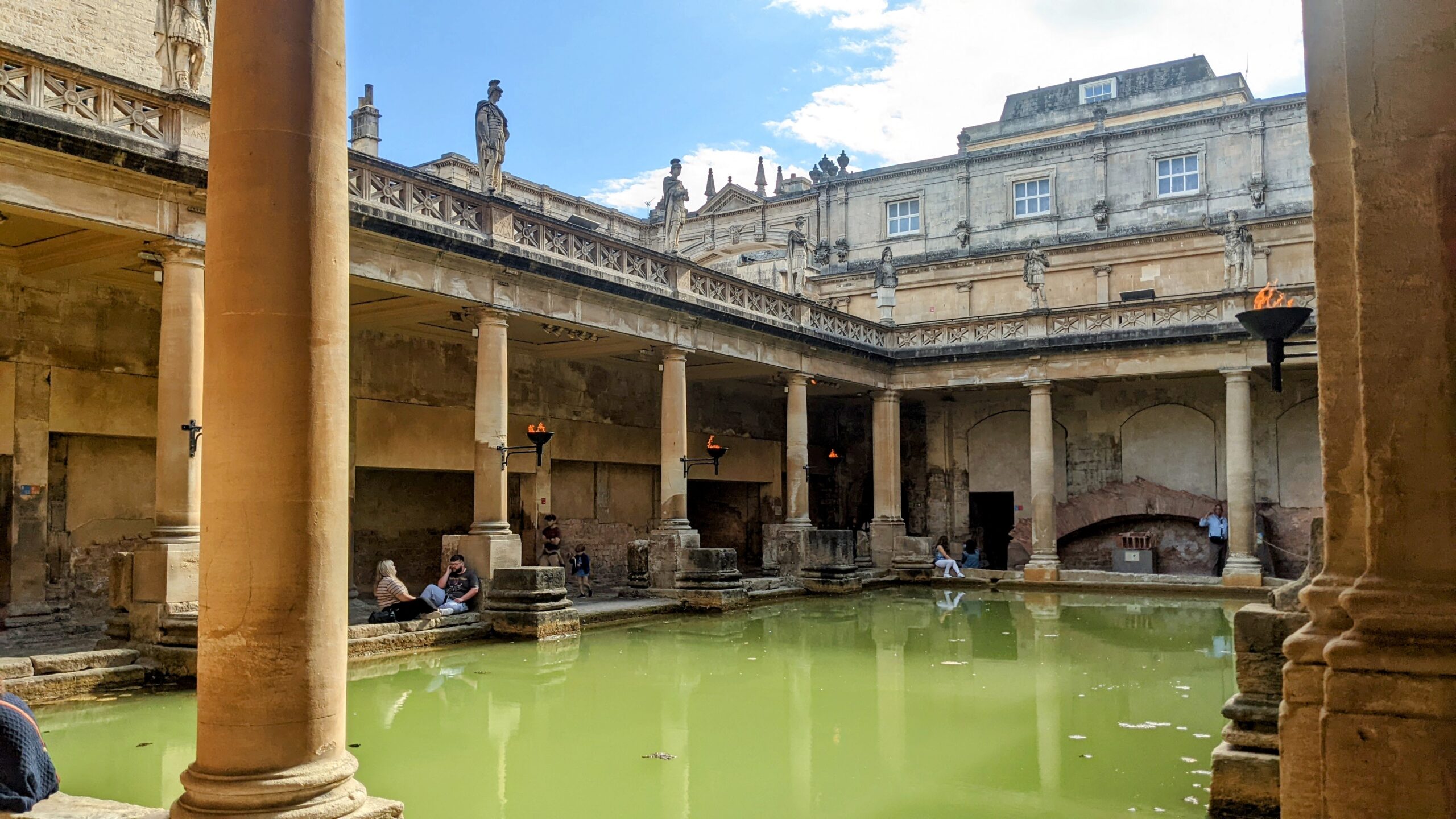
But why did a small town in the hills 100 miles west of London get such a royal treatment? Quite simply because Bath has been attracting tourists, particularly the well-to-do kind, for over 2,000 years. Bath boasts the UK’s only true hot springs, which were considered sacred by the Celtic people who lived here. They believed the water had healing powers, and attributed it to their goddess Sulis, to whom they erected shrines here. Centuries later, in 60 AD, the occupying Romans exploited the springs to build one of their sumptuous bath houses. Romans took bathing very seriously, and their bath complexes were temples to the art of self-care. Every self-respecting Roman city had at least one, and none are better preserved than the ones at Bath. Through an ingenious gravity-fed plumbing system, the spring water was channeled into pools of various sizes and temperatures, which were constantly refreshed before draining into an underground aqueduct that flowed to the River Avon. Enjoyed by people of all ages, men and women, aristocrats and slaves, Roman baths were a place where you could spend hours, oiling your skin, sweating out your impurities in the sauna, luxuriating in the caldarium hot pool, before taking a chilly dip in the frigidarium cold pool. All while gossiping with your friends and neighbors or working out business or political deals.
But the baths here were special even by Roman standards. They named the spot Aquae Sulis, or “waters of Sulis”, and built a temple next to the baths dedicated to a hybrid Celtic-Roman goddess named Sulis Minerva, then encircled all of it with a small town. The sacred springs were known for relieving pains and illnesses, and people journeyed from all over Roman Britannia and the Empire to take the waters—as evidenced by coins, as well as messages inscribed on tablets addressed to the goddess, that were thrown into the spring.
After the Romans left, the springs continued to be enjoyed over the centuries, and new pools were built. Queen Anne (wife of King James) came here to take the waters for her health in 1613. But somehow (and I don’t quite understand how this happens), most of the original Roman bath complex had by this point been built over and forgotten. It wasn’t until 1878 that they were accidentally rediscovered. The city mounted an ambitious campaign to buy up the land, demolish the existing buildings, unearth the old baths, and reinvent them as a luxurious Victorian spa, complete with a fancy restaurant called the Pump Room. They opened in 1890 and attracted 100,000 eager patrons that first year alone, who believed, just as the Celts & Romans did, that the waters had healing powers that could treat everything from fertility problems to skin diseases.


But well before this, Bath was already a fashionable English resort town, attracting a roster of the kingdom’s most influential—and those aspiring to be. Regular coach service from London was established as early as 1657. By the following century, the city has its own theater and, by 1771, a posh ballroom complex called the “Assembly Rooms“, designed for dancing, music, and the mixing of polite company. They were described as “the most noble and elegant of any in the kingdom” and quickly became the center of the town’s high society.
Bath had become perhaps the most fashionable of the rapidly developing British spa towns, attracting many notable visitors. Master of ceremonies Beau Nash, who presided over the city’s social life from 1705 until his death in 1761, drew up a code of behaviour for public entertainments. In 1816, [Bath] was described as “a seat of amusement and dissipation”, where “scenes of extravagance in this receptacle of the wealthy and the idle, the weak and designing” were habitual.
Wikipedia
By 1801, Bath boasted a population of 40,000, making it one of the largest cities in Britain at the time. (Of course, many other British cities have grown by leaps and bounds since then, but Bath has not.) That same year, Jane Austen took up residence here, and the town helped inspire her novels Persuasion and Northanger Abbey. Today, much of the town probably looks much the same as in Ms. Austen’s time, thanks to a concerted effort to keep it that way. Even a series of devastating German bombing raids during WWII, cynically intended to destroy the country’s cultural and historical treasures, couldn’t deter the Bathonians; they quickly rebuilt most of their architectural treasures exactly as they had been. Today, this time capsule of a city—the whole thing—is designated a World Heritage Site.
That’s not to say that Bath isn’t a modern city; it’s just that most of the modern stuff is cleverly hidden beneath the cobblestones and elegant Georgian facades. The town is chock-full of wonderful little shops, restaurants, and drinking establishments which seem far more delightful and tasteful—and far less kitschy—than those in most tourist towns. Adding to the ambience is the setting; the town nestles in a valley surrounded by green hills, cradled by the meandering Avon River, creating a picture-perfect setting worthy of a Thomas Kinkade painting. It’s impossible to resist the charm of Bath. I dare you to try.
This was actually my third trip to Bath—I visited once back when I studied in London in 1999, and then again in 2001. Of course, we’ve been trying on this trip to go to places we haven’t been before, but as with London, I felt no sense of been-there-done-that on my return to Bath. Everything felt wonderfully fresh and just a bit familiar, like the joy of catching up with an old friend from childhood. I was surprised by the things I remembered, and yet how much I had forgotten.
Bath spread herself before us, like a beautiful dowager giving a reception. Bath…has the rare trick of surprising you all over again. You know very well it is like that, yet somehow your memory must have diminished the wonder of it, for there it is, taking your breath away again.
J.B. Priestley in ‘English Journey’, published 1934
And anyway, there was no time to get bored, because we were only spending 2½ days here. We were still with Amy’s sister, who had planned our itinerary. We were sharing a charming (but rather cramped) Airbnb with her and her family in the old downtown. Naturally, Griffin was far more interested in playing (and tussling) with his cousins than going to any more museums or cathedrals, but we managed to get a few in anyway. Especially since it wasn’t getting dark until 10pm!
Here were some of the highlights from our stay:
The Roman Baths: Of course, you can’t visit Bath and not visit the baths, and this was the first thing we did after we got settled. Sadly, you can no longer take a dip in the pools like the Victorians did (but there is a new, upscale hot springs resort up the street where you can). The city has transformed the original bath complex into a stellar museum that showcases the history of the baths and even tries to recreate a bit of the Roman experience with costumed actors and virtual Roman tour guides. We spent around two hours there, and I was surprised by how long the tour held the kids’ interest. I loved tracing the route of the original Roman plumbing, which still fills the pools today. One thing that the Victorians did that you can still do: drink the hot spring water! (It’s a bit…odd-tasting.)


Bath Abbey: Figuratively overshadowed by the Roman Baths, though it looms right over them, the beautiful Bath Abbey might be reason alone to visit Bath, if there weren’t already a dozen other reasons. Originally founded way back in the 7th century, the current church dates from the 12th and 16th centuries. English cathedrals are far less ornate and overwrought than their Roman counterparts—no gloomy Caravaggios covering the walls here—opting instead to let the graceful architecture and light do the talking. Nowhere is this more obvious than in Bath’s graceful abbey. I had forgotten the delicate, lacey fan vaults that seem like they couldn’t possibly be carved from stone, much less hold up the roof. Though we never made it on the tower tour, I ducked into the Abbey a couple of times, once with the kids. Griffin’s head nearly exploded when he tried to count all the images of angels and shields he could find inside! Cool tidbit: the front of the Abbey is discreetly adorned with a pair of stone ladders with angels climbing up them, and a few tumbling down—a not-so-subtle metaphor.
The riverside & the Pulteney Bridge: England has some of the best gardens in the world, and Bath surely has some of the best in England. (I head a rumor that the town is sometimes disqualified from the annual Britain in Bloom contest to let other towns have a chance!) One of the best examples is the impeccably maintained Parade Gardens, tucked between the Abbey and the tree-lined river. Overlooking it is the impossibly quaint Pulteney Bridge, a stone triple-arch dating from 1774 that is lined with little shops on both sides, apparently one of only four such bridges in the world. (We had just seen two of the others: the Ponte Vecchio in Florence and the Rialto in Venice.) Standing on the riverside, you never really get tired of this view, especially at sunset!


Promenading around the town: Bath is a pleasure just to walk around, with myriad street performers around the downtown to keep you entertained. Of course, we had to spend some time exploring Bath’s architectural wonders, so we wandered uptown to the famous Royal Crescent and the Circus. Both are a row of stately, perfectly-matched townhomes, the first set in a large half-circle overlooking a massive lawn, the second a full circle encompassing a small park. (Together with Brock St, which connects the two, they form a funny question mark when seen from above.) These orderly homes, with their proud columns and perfect alignment, are quite a sight, especially after the chaotic, jumbled hillside villages of Italy!
The Fashion Museum: While the aforementioned Assembly Rooms are still used for events, part of the complex has been converted, appropriately, into a museum dedicated to showcasing the mind-numbing range of clothing for men, women and children from the past few centuries, with a preponderance of the stuff that gets paraded around in Bridgerton. Amy learned some of the fashion etiquette of bygone eras, such as the prescribed 2½ year schedule of attire for a grieving widow, while Rachel and the kids enjoyed dressing up in some period costumes.

Dinner with Tam: Somehow it worked out that our friend Tam, formerly of Santa Barbara but now living in Hawaii, was going to be in England at the same time as us. We managed to coordinate an evening together in Bath, where we enjoyed some excellent Turkish food and sparkling conversation, some strong gin cocktails, and snapping sunset selfies on the riverside at 9:30pm! Tam agreed that no matter how many times you visit, you never tire of Bath!
The Bath Carnival: Our last day in town, an absolutely radiant Saturday morning, happened to coincide with the annual Bath Carnival, which looks somewhat similar to Santa Barbara’s Solstice festival. I was sad to leave town before the parade, which promised to be quite spectacular—but that was probably a good thing logistically. We did spend a couple hours with the kids enjoying some wholesome festivities, music & food at the Sydney Gardens park. I was surprised to discover that Bath is not inhabited solely by stuffy old retirees (pensioners, the Brits call them); there are actually tons of families too, many of them quite normal-looking. There’s nothing more adorable than watching small children toddering around the playground speaking in their cute English accent!
Pasties: Originating in nearby Cornwall, pasties are little savory hand-pies, typically stuffed with meat & potatoes wrapped in a flaky pastry. I’ve been obsessed with them since childhood, as there were a couple of pasty shops in a nearby Gold Rush town that had been settled by Cornish miners. I was delighted to find that Bath had a couple of pasty shops, both offering vegan pasty options, and I think I stopped in probably four times in 2½ days!
Shopping: Despite our limited time there, we somehow spent a lot of time in the shops. The kids made themselves a little crazy in an incredibly well-stocked candy store. Griffin and I both got some upgraded footwear, having already worn out some of the shoes we had brought. Amy enjoyed just window shopping in all the quaint boutiques.
Though I could have easily spent our full 2½ days in Bath enjoying the town, Rachel and her family wanted to spend one of those days doing a day trip to explore more sights in the region. So the seven of us piled into a large van they rented in Bath and hit the road…which was a bit of a harrowing experience given that there are few straight or wide roads in this part of England! (Props to Rachel’s husband Scott for negotiating them.) We headed to:


Salisbury & the Salisbury Cathedral: No, this is not the namesake of those awful Salisbury steaks TV dinners. (Those are actually an American invention named after one Dr. Salisbury.) It is a wonderfully charming and often overlooked town in southwest England, about 30 miles from Bath. Its claim to fame is its Gothic cathedral, which boasts the tallest spire in England at over 400 ft. The cathedral is excessively massive for such a small town, but actually predates it. The original cathedral was built inside the nearby hillfort of Sarum way back in 1092. (Check out the sweeping historical novel Sarum, which I read many years ago.) But 130 years later, after some disputes with the secular authorities, the cathedral was moved, stone by stone, to a empty meadow by a river two miles away, where it was rebuilt and expanded. There, a new town grew up around it. The cathedral is an impressive structure, built on an incredibly shallow, water-logged gravel foundation; it’s a marvel that it stands up, and there’s speculation that if the ground ever dries up, the cathedral will become unstable and collapse. I loved seeing the place after having watched the TV mini-series Pillars of the Earth a few years earlier, based on the historical novel of the same name by Ken Follett, which chronicles the building of a fictional cathedral in England in the 12th century, based loosely on the one at Salisbury. Meanwhile, legal history buffs will appreciate that the cathedral is home to the best preserved of four extant copies of the Magna Carta from 1215, which we got to see in a dimly-lit display cave. I also enjoyed seeing the cathedral’s original clock mechanism, now removed from the tower but still operating, which dates from about 1386 and is supposedly the oldest working clock in the world. I’m not sure the kids really appreciated the archaic legal document, the antique clock, or the cathedral, but they did love getting ice cream in Salisbury’s adorable central square, and we enjoyed exploring the town a bit on foot. I was tickled to spot the ruins of old Sarum on a hill as we drove out of town.

Stonehenge: Our second destination, just a few miles from Salisbury, needs no introduction. Somehow, in all my time in England, I never managed to visit this, probably the most iconic English landmark outside London. So it was about time. Curiously, when you roll up, there are no stones in sight. Where do they keep them? The small but tasteful visitor center has an excellent interactive museum that tells the story of the ancient monument, complete with an outdoor reconstruction of the sort of huts that the builders of Stonehenge might have lived in. But it turns out that all this is more than a mile away and not visible from the actual site. To get there, you can walk…or hop on a shuttle bus that departs every few minutes. This clever arrangement leaves the stone circle isolated on its hilltop with few signs of civilization to clutter the view—well, except for the crowds of visitors, the livestock fences, a handful of motorhomes and cars that get as close as they can on farm roads to avoid paying the entrance fee, and that busy 2-lane motorway a few hundred meters away! (All strategically omitted from the best photos, of course.) But if you can ignore that, it’s actually a surprisingly quiet and peaceful spot, set amongst the rolling green hills of Wiltshire. Especially since we got there late in the day, just before closing, rewarding us with smaller crowds. I was surprised to find that the stones, while definitely massive, are actually smaller than I expected—most photos seem to dramatize and exaggerate the size. I was also intrigued to learn that the place was not all built in one go, but over several phases, out of different stones, possibly even by different peoples, between 3000 BC to 2000 BC. There is even evidence of large-scale construction here dating back as far as 8000 BC, suggesting that this site has been considered important for a very long time. I was also surprised to discover that there are lots of large burial mounds scattered around the area, which look like part of the natural topography until you know to look for them, as it was probably considered auspicious to be buried within sight of these stones. But whomever it was that built this place left no written record, so we don’t know for sure why the stones are here or what they used the for, how they were schlepped from up to 160 miles away, or how they were lifted into position by these prehistoric builders. Everything we think we know about Stonehenge is speculation based on archaeological findings, though there is so much myth and legend surrounding the site by now that it’s hard to know what is likely true. Regardless of what you believe about them, the stones are still pretty stunning, and you can’t help but wonder about how this place might have looked in its heyday, especially during the winter solstice events that very likely happened here. Is Stonehenge worth visiting? Definitely. But England, Scotland, and Ireland are chock-full of similar, if slightly less famous, prehistoric stone circles and other such monuments, and we enjoyed seeking out some of these more remote and untrammeled spots during the coming few weeks. You should too.
In summary, we immensely enjoyed our time in Bath and beyond, and would happily return anytime. In fact, the only thing we could complain about was the seagulls that woke us up every morning…rather a surprise since Bath is some 25 km away from the sea! Though we didn’t have much time there, it all felt reasonably relaxed. I actually spent a lot of time being a history geek and reading up on the predecessors of the English people, including the Celts, the Romans, the Angles, the Saxons the Jutes, the Norse, and the Normans, and the various interactions (violent and otherwise) between them over the centuries. Turns out that my ancestors are real mutts, just like their language! Meanwhile, Amy and I watched the 2005 version of Pride & Prejudice (ironically, one of the few Jane Austen films not filmed in Bath), after which she declared that her prejudice against period dramas was misplaced and that she is now a fan. Go figure!
Next stop on our English adventure: the Cotswolds!


