
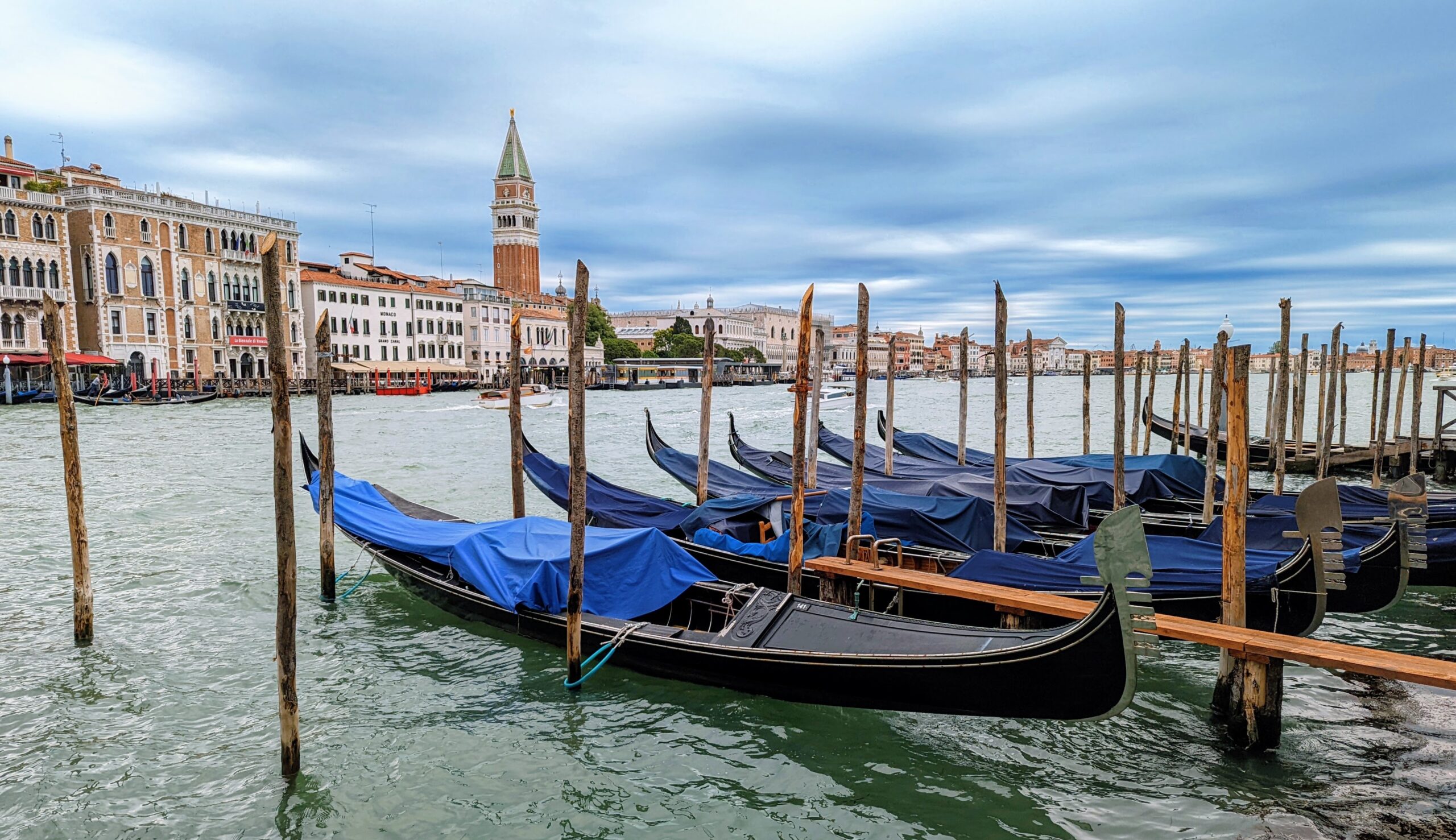
Venice
I suppose our next destination needs little introduction. Is there any kindergartner who doesn’t know that Venice is that magical city built on the water where they have boats instead of cars? It’s not hype—Venice is every bit as unbelievable as it seems. I mean,The New York Times called it “undoubtedly the most beautiful city built by man”. So if you haven’t been, you really must visit someday. Except that…everybody is doing just that, and the place is getting quite overrun. Venice is slowly drowning, but in in a sea of humanity. (Consider: the old city these days has about 55,000 residents, but receives 22–30 million tourists a year. Maybe more this year!) So on second thought, maybe you should skip it. Really, it’s not worth your time. Just watch The Italian Job or something. 😉
I was last here in 2005, on my European grand tour. My mom and Amy have been here as well. So we might all have skipped Venice in favor of experiencing something new, except…well, we were going right past it, and how can you skip Venice? Luckily, it’s a bigger place than it seems, and by our third day, we got away from the crowds and the souvenir shops and found some quiet corners—and even a park!—where we had the space to fall in love with her all over again.
Right about now, I throw in a little history lesson, because I love history, and for me, it provides context for understanding a place. And even if you skip past these bits—I mean, not you, of course, but other less devoted and intellectual readers—I include it here so that at least I can remember what I learned (or re-learned) when I came to these places. In this case, I think Wikipedia’s introduction to the city says it far better than I could (edited here for brevity):
Venice…is built on a group of 118 small islands that are separated by canals and linked by over 400 bridges. The lagoon and a part of the city are listed as a UNESCO World Heritage Site. Venice has been known as “La Dominante”, “La Serenissima”, “Queen of the Adriatic“, “City of Water”, “City of Masks”, “City of Bridges”, “The Floating City”, and “City of Canals”.
The name is derived from the ancient Veneti people who inhabited the region by the 10th century BC. The city was historically the capital of the Republic of Venice for over a millennium, from 697 to 1797. It was a major financial and maritime power during the Middle Ages and Renaissance, and a staging area for the Crusades…as well as an important center of commerce—especially silk, grain, and spice, and of art from the 13th century to the end of the 17th. The city-state of Venice is considered to have been the first real international financial center, emerging in the 9th century and reaching its greatest prominence in the 14th century. By the late 13th century, Venice was [already] the most prosperous city in all of Europe. [It] is known for several important artistic movements—especially during the Renaissance period—and has played an important role in the history of instrumental and operatic music.
Wikipedia
Long story short, Venice isn’t just beautiful; it was also a bad ass…back when the rest of Europe was still deep in the so-called Dark Ages. Its ship-building yards (the Arsenale) were unrivalled in the world, working like an early assembly line that, at its peak, could churn out new galleys at the rate of one a day. Venice built and controlled a small maritime empire that stretched to modern-day Turkey, long before the Spanish or the British ones emerged. We keep finding traces of its reach and power everywhere in the Med and especially the Adriatic: whole cities and islands that were but outposts and/or vassals of the mighty Venice. But one of the things I find most fascinating is that wasn’t led by an emperor or king; it was a republic controlled by a series of councils and judiciaries that ensured that Venice could not be dominated by any one man or faction. Granted, the members of these groups were always men and generally chosen from the patrician families of the city, but it was nonetheless a surprisingly enlightened form of government at the time. Wikipedia again:
The Venetian governmental structure was similar in some ways to the republican system of ancient Rome, with an elected chief executive (the doge), a senator-like assembly of nobles, and the general citizenry with limited political power, who originally had the power to grant or withhold their approval of each newly elected doge. Venice remained a republic throughout its independent period, and politics and the military were kept separate.
Venice was also enlightened in other ways:
Although the people of Venice generally remained orthodox Roman Catholics, the state of Venice was notable for its freedom from religious fanaticism, and executed nobody for religious heresy during the Counter-Reformation. This apparent lack of zeal contributed to Venice’s frequent conflicts with the papacy.
The newly invented German printing press spread rapidly throughout Europe in the 15th century, and Venice was quick to adopt it. By 1482, Venice was the printing capital of the world; [and its] leading printer…invented paperback books that could be carried in a saddlebag.

My favorite tale of Venice’s liberalism is the (mostly) true story of its courtesans told in the very engaging and often cheeky period film Dangerous Beauty, which I re-watched while here. Check it out.
But Venice’s superiority couldn’t last forever, and it began a long decline in the 15th century after suffering a number of outbreaks of the Black Plague, a series of defeats by the Ottomans, and having its trade dominance undermined by new routes to India and its ships outperformed by newer designs. It was finally conquered by Napoleon in 1797, and after that, it flip-flopped between being part of the Austrian Empire and the Kingdom of Italy, until becoming a permanent part of the latter in 1866. But even though its power faded, Venice’s beauty and allure never did.
What impressed me most on this visit was that the city isn’t just beautiful from the outside. This time, we toured the Doge’s Palace (Palazzo Ducale), Venice’s seat of government. It doesn’t look so terribly impressive from the outside—it’s a blank white box decorated with a tediously monotonous set of arches—but inside, I beheld what must be the most elaborate and grandiose treatment ever given to the interior of a building by mankind. Each room was more stupendous than the last, until I reached the Hall of the Great Council. (Somebody called it the “Sexiest Voting Room You’ll Ever See”, and I agree.) It’s one of the largest rooms in Europe, containing the world’s largest painted canvas and countless other artistic treasures covering every square inch of its walls and ceiling. No photo can do it justice. I was blown away, which I didn’t think was possible after how many palaces as we’ve now seen. I’ve since learned that so many of the artistic accomplishments of the Renaissance—for instance, the richly decorated Palazzo Vecchio in Florence, which we saw a week later—were inspired by and an attempt to emulate the wonders of Venice.


But I’m getting ahead of myself here. Let me tell you about our brief visit in a slightly more chronological order. It was a Sunday morning when we left Trieste under stormy skies for the relatively short train ride west along the Adriatic. Though we passed plenty of picturesque towns, I was surprised by the amount of industry, especially the monstrous shipbuilding facilities outside of Trieste and even within Venice itself—the city’s boundaries actually include a considerable amount of the mainland, where where most of its population lives. Much has been said about how the industrious and disciplined northern Italians differ from their more lackadaisical brethren in the south, and we were getting a taste of it here. (If you have a fancy Italian espresso machine, an Italian car, or even some Italian apparel, chances are it was made in northern Italy.)
It wasn’t long before our train was crossing the 4 km earthen bridge (Ponte della Libertà) that was built in 1933 to connect Venice to the mainland. Yes, Venice has a train station! Quite a busy one, actually, since this is how most tourists arrive. But what I did not recall from my last visit is that the bridge also has a road, so that you can actually drive to Venice too!
Amy has somehow secured an apartment in Venice itself, an Airbnb on the northwest corner of the island, where the bridge connects. Our neighborhood, Santa Croce, has the distinction of being the only one with a parking lot and even a parking structure. It’s where both municipal buses and tour coaches disgorge their passengers, and where the cruise ships do the same on a much larger scale. Needless to say, a busy, bustling place. But somehow, despite being right next to all of that, our homey little second-story apartment, which overlooked a nondescript canal, was quite peaceful, probably quieter than most in Venice. (And a heck of a lot less work to get to!) The wonderful woman who waited to check us in was a native and had raised several children there, but like most Venetians, she had since moved to the mainland where real estate was much more affordable. She now commuted in to help set up tourists like us with apartments that once were home to people like her. She didn’t seem particularly bitter about it, and spent a good long time cheerfully poring over a city map with us, showing us the best places to go.
After settling in, we followed her advice and headed out to get something to eat in Campo Santa Margherita, one of the less pretentious and overpriced squares in the city. Then we spent the last couple hours of daylight on one of my spontaneous self-guided walking tours, circumnavigating the southernmost section of Venice, Dorsoduro, one of its least crowded, under a cloudy, moody sky.


The next morning, the weather was bright and warm again. (And that’s how it was to stay—the entire next month in Italy was hot hot, hot!) I snuck out early and was surprised to find a relatively inexpensive bakery and café near our apartment (which I returned to the next two mornings), and decided that being in one of the less touristy neighborhoods had its advantages. Once everybody was up, we dove into the melee and followed the throngs of tourists down the well-worn streets of the Cannaregio neighborhood, past gobs of souvenir shops, overpriced cannoli stands and chocolate shops, and countless mediocre eateries claiming to serve authentic Italian dishes.

We finally ditched the crowds by turning down a small, dark, unmarked sotoportego, one of Venice’s distinctive passageways that run under buildings. We had entered the old Jewish Ghetto, the world’s first (and from which the English word ghetto originated), dating from 1516. It was this relatively small, walled neighborhood where the few hundred Jewish merchants and their families then in Venice were compelled to live, placed under guard at their own expense and subject to heavy fines if caught outside after hours. It’s still not clear to me why the Venetians decided to lock up their Jews, but according to some sources, it was perhaps a more tolerant approach than much of the rest of Christendom took at the time:
Jews within Venice therefore found a secure place to live despite the restrictions imposed on them, and were soon joined by others fleeing persecution in central Europe. The population was swelled by the arrival of Marrani Jews, expelled from Spain and Portugal when they refused to convert. As the reputation of the ghetto spread, the population (about 700 in 1516) grew, and when the English traveller Thomas Coryat visited in 1608, he recorded as many as 6,000 inhabitants. Living conditions were cramped and insanitary. Rooms could be reached only through other families’ living space. The gates were unlocked at dawn and locked by sunset and all residents were required to wear yellow headgear or a badge. In what was, for a time, a tolerant Venice, Jews were not forced to convert and the ghetto became a place of study and scholarship; money-lending and the sale of some goods…was allowed. Christians attended concerts in the ghetto, and Christian architects and builders created synagogues.
The Guardian, 500 years of the Venetian ghetto: commemoration and history
Despite the seclusion of the Venetian Ghetto, it became a thriving cultural hub over time. There many early Hebrew books were first published, including the Hebrew Bible and the Babylonian Talmud. In fact, nearly a third of Hebrew books printed in Europe before 1650 were printed in Venice.
Library of Congress law blog
Today, the ghetto is relatively unremarkable except for its history, and though apparently many Jews still live there today, there are few clues to what it once was except for a few nondescript synagogues and kosher bakeries.
After grabbing lunch, we rejoined the crowds and made our way towards the gravitational center of Venice, St. Mark’s Square. It was here that we toured the Doge’s Palace for a couple of hours. Amy, Griffin, and my mom cut their visit short after Griffin lost interest and had to go potty. I continued meandering through to the old prisons that are connected to the Doge’s Palace across a canal by the famous and photogenic Bridge of Sighs. After their sentences had been handed down in the courtrooms of the palace, prisoners were taken across this secure, enclosed passageway to their cells, where many stayed until their deaths, and the bridge’s name supposedly derives from their sighs upon seeing a last glimpse of the outside world through the small latticed windows. That afternoon, a new bride and a groom were using it as a backdrop for a photoshoot, and I wondered if they knew its true purpose. (A pretty bridge to a lifelong prison…is there a metaphor for marriage here?)


That was the only obligatory tourist activity we did during our brief sojourn in Venice. We skipped St. Mark’s Basilica next door, as well as a climb up St. Mark’s Campanile, that iconic tower in the middle of the plaza. The lines were just too long and there simply wasn’t time. We also vetoed a ride in the gondolas, which looked fun, but…we just couldn’t justify the €100 price tag. Instead, we spent the remainder of the day as we had spent the morning, wandering both the well-trod routes and the lesser-known back alleys, finding our way over the famous Rialto Bridge and through a market square that I somehow remembered from my last visit. Our day ended at a little trattoria we found next to one of the smaller, quieter canals, where we watched an occasional gondolier try to negotiate a particularly tight corner. We enjoyed fresh fish and pasta and far too much wine as we celebrated my mom’s last night in Italy, wrapping up three weeks of our journeying with us.


The next morning, she headed to the airport while we ventured out for our final day in Venice. We started the morning by taking a vaporetto (Venice’s public water buses) to the nearby island of Murano, famous for its glass art workshops, where we watched one of the requisite tourist glassblowing demonstrations before being led into an overpriced gift shop of glass art. (One of the attendants singled us out as high rollers—the couple with the six year-old?—and took us upstairs for a private viewing of the even more expensive tchotchkes. Sadly for him, we weren’t buying any hand-blown chandeliers this trip.) There isn’t a whole lot else to see on Murano except a couple of canals, an old church, and a handful of cute shops and restaurants. And it was hot. So we snapped a few photos, grabbed a snack in the square, and boarded another vaporetto back to central Venice.


On our way back, we were intrigued to pass an island (San Michele) that is one large walled, tree-lined cemetery. While everybody else got off at the first Venice stop, we stayed on board as the boat circumnavigated the city, giving us a quick and cheap way to see quite a lot of it. We finally hopped off at the southernmost tip of the city at a good sized waterfront park, apparently created by Napoleon, next to a working class neighborhood where tourists rarely venture. We wandered the quiet tree-lined paths, past a playground, to the Giardini della Biennale, an expansive landscaped space which has hosted the Venice Biennale Art Festival since 1895. We wove through a few more humble locals-only residential avenues, where laundry hung on lines over the street, then popped out a sotoportego onto the waterfront again. Here we found a pair of small parks hosting an unexpected exhibit of sculptures, most of them made from resin, Amy & Griffin’s favorite art medium.


A few steps away, we found the lovely Via Giuseppe Garibaldi, the only straight, wide street I know of in Venice, a so-called rio tera, created when a canal down the middle was filled in, unifying the two fondamenta (streets with a canal on one side and buildings on the other) into one large boulevard. We dined at an empty sushi restaurant and watched a leisurely procession of pedestrians go by, whom we suspected were mostly locals. Then we threaded our way across the city, past the Arsenale, through various other adorable squares, past the Bridge of Sighs through St. Mark’s Square, over the Grand Canal, and through the heart of Venice, back to our apartment just before sunset to pack up for our departure the next morning.


After spending most of the previous day submerged in the mad crush of tourists, we were grateful to have spent the afternoon exploring another side of Venice, one that seemed considerably more relaxed and authentic—and considerably less tacky and commercial. It was gratifying to know that even as overrun as Venice may be, it’s still a big enough place to offer some quiet corners where you can sit and appreciate the patinaed glory of La Serenissima for yourself.
Next stop: Florence!


